Wenchang, Hainan, is well known for its coconut industry and has developed a growing ecosystem around coconut cultivation, processing, and value-added products. While coconut milk, coconut oil, and coconut candy are popular food products, the coconut husk also provides valuable materials for agricultural and industrial applications.
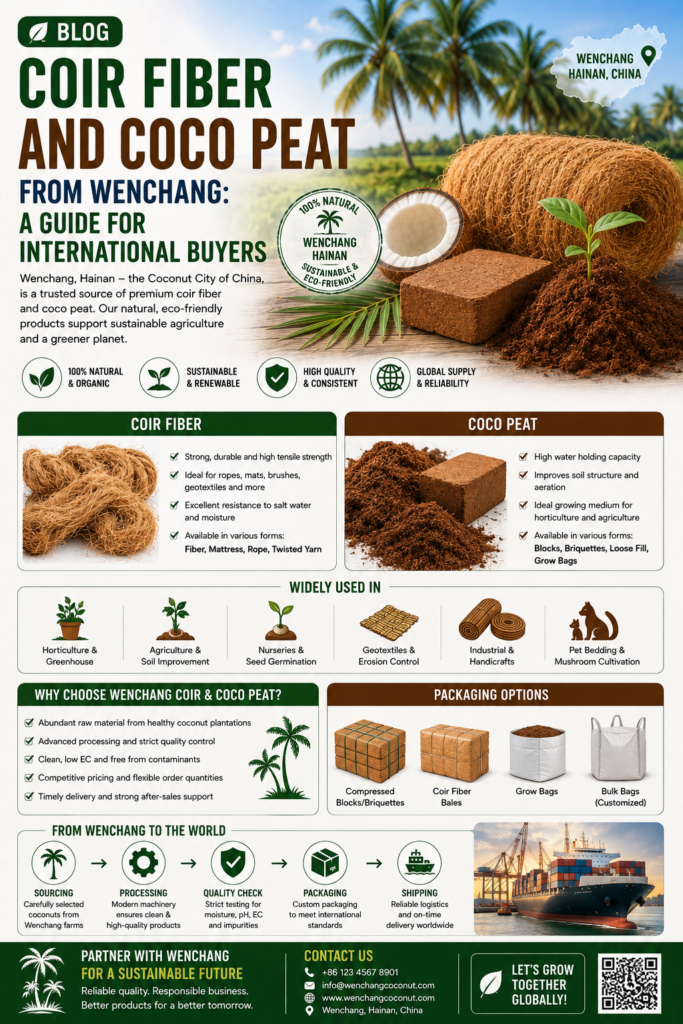
Two important coconut by-products are coir fiber and coco peat.
For international buyers, these products can be useful for horticulture, nurseries, greenhouse cultivation, landscaping, erosion control, growing media, and other applications.
Wenchang can therefore be an interesting sourcing location for companies looking to purchase coconut-based agricultural materials from China.
This guide explains the differences between coir fiber and coco peat, their applications, specifications, packaging, sourcing process, and important considerations for international buyers.
What Are Coir Fiber and Coco Peat?
Both products are obtained from the coconut husk, but they have different characteristics and applications.
Coir fiber is the strong fibrous material separated from coconut husks.
Coco peat, also known as coir pith or coco coir growing medium, is the fine material remaining after processing the coconut husk.
The basic process can be simplified as:
Coconut Husk → Processing → Coir Fiber + Coco Peat
Instead of treating coconut husks as waste, processors can convert them into useful agricultural and industrial materials.
Why Source Coir Products From Wenchang?
Wenchang has a long-established coconut-growing tradition and is one of the important coconut-producing areas in Hainan.
The development of coconut processing in the region has created opportunities to utilize different parts of the coconut, including the husk.
For international buyers, sourcing from a coconut-producing region can offer an opportunity to explore multiple coconut products through related suppliers and processing networks.
Potential products include:
- Coir fiber
- Coco peat
- Coco peat blocks
- Coco peat bricks
- Grow bags
- Coir mats
- Coir ropes
- Coconut shell charcoal
- Coconut shell powder
- Coconut-based agricultural products
Coir Fiber: What Is It?
Coir fiber is a natural fiber extracted from coconut husks.
It is known for its durability and resistance to moisture compared with many other natural fibers.
Coir fiber can be processed into different grades and lengths depending on its intended application.
International buyers may purchase coir fiber as:
- Loose fiber
- Baled fiber
- Compressed fiber
- Long fiber
- Short fiber
- Brown coir
- Processed coir
The correct specification depends on the buyer’s intended application.
Applications of Coir Fiber
Coir fiber has a wide range of potential uses.
1. Agricultural Products
Coir fiber can be used in agricultural and horticultural products such as:
- Growing materials
- Plant-support materials
- Nursery products
- Mulching materials
- Soil-cover products
2. Erosion Control
Coir fiber is commonly used to manufacture erosion-control products.
Examples include:
- Coir erosion-control blankets
- Coir logs
- Coir mats
- Coir geotextiles
- Slope-protection materials
These products can help stabilize soil and support vegetation establishment.
3. Horticulture
Processed coir materials can be incorporated into growing systems and horticultural products.
They can be useful for:
- Nurseries
- Greenhouses
- Landscaping
- Gardening
- Plant propagation
4. Ropes and Twine
Coir fiber can be twisted into:
- Rope
- Twine
- Cord
- Netting
These products can be used for agricultural, gardening, decorative, and industrial purposes.
5. Mats and Rugs
Coir is also used to produce:
- Door mats
- Floor mats
- Entrance mats
- Decorative mats
- Garden mats
Natural-fiber products can be attractive to buyers looking for renewable-material alternatives.
Coco Peat: What Is It?
Coco peat is the fine material obtained from coconut husks during coir processing.
It is widely used as a growing medium because of its ability to retain water while maintaining air spaces around plant roots.
Coco peat can be supplied in several forms.
Loose Coco Peat
Loose coco peat is suitable for buyers who already have their own mixing or processing systems.
Coco Peat Blocks
Compressed coco peat blocks reduce transportation volume.
After adding water, the compressed material expands significantly.
Coco Peat Bricks
Smaller compressed bricks can be convenient for retail gardening and smaller-scale applications.
Grow Bags
Coco peat can also be processed into ready-to-use growing bags for greenhouse and commercial cultivation.
Applications of Coco Peat
Coco peat is particularly popular in horticulture.
1. Greenhouse Cultivation
Commercial growers can use coco-based growing media for crops cultivated under controlled conditions.
2. Nurseries
Coco peat can be used for seed propagation and nursery production.
3. Hydroponics
Coco-based growing media are widely used in certain hydroponic and soilless cultivation systems.
4. Seed Germination
Coco peat can provide a lightweight growing medium for seed starting.
5. Indoor Gardening
Retail coco peat products can be marketed to home gardeners.
6. Landscaping
Coco peat can be incorporated into growing media and soil-improvement products.
Coir Fiber vs Coco Peat
Although both come from coconut husks, they serve different purposes.
| Feature | Coir Fiber | Coco Peat |
|---|---|---|
| Source | Coconut husk | Coconut husk |
| Texture | Fibrous | Fine/pith-like |
| Main use | Fiber products | Growing media |
| Agriculture | Erosion control, support | Plant cultivation |
| Horticulture | Supporting material | Growing medium |
| Packaging | Bales, compressed bundles | Blocks, bricks, bags |
| Typical buyers | Agricultural & industrial companies | Nurseries & growers |
Some international buyers may purchase both products because they serve different parts of the agricultural supply chain.
Important Coco Peat Specifications
When purchasing coco peat, buyers should not simply ask for “coco peat.”
They should provide technical specifications.
Important parameters can include:
Expansion
This indicates how much the compressed block expands after hydration.
Moisture Content
Excessive moisture can increase shipping weight and affect storage.
pH
The pH level should be appropriate for the intended crops or application.
Electrical Conductivity
EC is important for growers because excessive soluble salts can affect plant growth.
Fiber Content
Different applications require different proportions of fine pith and fiber.
Particle Size
Coco peat can be supplied in different particle-size ranges.
Compression Ratio
Compression affects transportation efficiency and final expansion.
Important Coir Fiber Specifications
For coir fiber, buyers should consider:
- Fiber length
- Fiber thickness
- Moisture
- Color
- Cleanliness
- Fiber strength
- Foreign-material content
- Processing method
- Bale weight
- Packaging
The required specification depends on the final application.
For example, fiber intended for erosion-control mats may require different characteristics from fiber intended for rope production.
Washed vs Unwashed Coco Peat
International buyers may encounter washed, buffered, or unwashed coco peat.
The appropriate option depends on the intended agricultural application.
Unwashed Coco Peat
May contain higher levels of naturally occurring soluble salts.
Washed Coco Peat
Has been processed to reduce soluble salts.
Buffered Coco Peat
Has undergone additional treatment intended to manage certain chemical properties, particularly cation-related characteristics.
Buyers should specify the required treatment rather than assuming all coco peat products have the same characteristics.
How Coco Peat Blocks Are Made
A simplified manufacturing process can include:
- Coconut husks are collected.
- Husk material is processed to separate fibers and pith.
- The coco peat is screened.
- Unwanted materials are removed.
- The material may be washed or treated depending on specification.
- Moisture is controlled.
- The coco peat is compressed.
- Blocks or bricks are formed.
- Products are packed for transportation.
Manufacturing methods can vary between suppliers.
Why Compression Matters for International Shipping
Coco peat contains a large amount of air when loose.
Compression significantly reduces the volume during transportation.
For international buyers, this can be important because freight costs are often influenced by container volume.
A compressed coco peat block can therefore be much more economical to transport than loose material.
Buyers should compare suppliers based on the final expanded volume as well as the price per block.
Coco Peat Block Packaging
Common packaging options can include:
- Plastic wrapping
- Poly bags
- Cartons
- Pallets
- Bulk compressed blocks
Packaging should protect the product from moisture contamination and physical damage during transportation.
For retail products, buyers can request customized packaging and private labeling.
Coir Fiber Packaging
Coir fiber is commonly compressed into bales to reduce shipping volume.
Buyers should confirm:
- Bale dimensions
- Bale weight
- Number of bales per container
- Compression method
- Packaging material
- Container loading plan
These details can have a significant impact on shipping costs.
Container Loading
Before placing a large order, ask the supplier for a loading plan.
For example, request:
- Number of blocks per container
- Weight per block
- Total container weight
- Number of bales
- Estimated cubic volume
- Packaging dimensions
This allows buyers to calculate the approximate landed cost more accurately.
How to Choose a Wenchang Supplier
International buyers should evaluate suppliers carefully.
Look at:
Production Capacity
Can the supplier consistently produce the required quantity?
Product Quality
Does the product meet your technical specifications?
Export Experience
Has the supplier previously handled international shipments?
Packaging
Can the supplier provide packaging suitable for long-distance transportation?
Customization
Can they produce customized sizes, compression levels, or packaging?
Documentation
Can they provide the documents required for your market?
Questions to Ask a Coco Peat Supplier
Before requesting a quotation, send a clear specification.
Ask:
- What is the coco peat block size?
- What is the block weight?
- What is the expansion volume?
- What is the moisture percentage?
- What is the pH?
- What is the EC?
- What is the fiber percentage?
- Is the product washed?
- Is it buffered?
- What is the minimum order quantity?
- How many blocks fit in a container?
- What packaging is available?
- Can you provide samples?
- What is the production lead time?
- What export documents can you provide?
Questions to Ask a Coir Fiber Supplier
For coir fiber, ask:
- What is the fiber length?
- What is the moisture level?
- Is the fiber washed?
- What is the fiber strength?
- Is it mechanically processed?
- What is the bale weight?
- What are the bale dimensions?
- How many bales fit into a container?
- What is the minimum order quantity?
- Can you provide samples?
- What is the production capacity?
- Do you have export experience?
Request Samples Before Ordering
Samples are important when sourcing agricultural materials internationally.
For coco peat, test:
- Expansion
- Moisture
- pH
- EC
- Texture
- Fiber content
- Water absorption
For coir fiber, evaluate:
- Length
- Strength
- Cleanliness
- Moisture
- Color
- Uniformity
If the products will be used commercially, buyers should consider independent laboratory testing where appropriate.
Quality Control Before Shipment
Quality control should be based on agreed specifications.
A buyer can establish an inspection checklist covering:
- Product weight
- Dimensions
- Moisture
- Packaging
- Quantity
- Product appearance
- Contamination
- Technical parameters
For large orders, an independent pre-shipment inspection can provide additional assurance.
Private-Label Coco Peat Products
International gardening brands can consider private-label coco peat products.
Potential retail products include:
- Coco peat bricks
- Coco peat blocks
- Seed-starting blocks
- Gardening mixes
- Grow bags
- Compressed growing media
A supplier may be able to customize:
- Product size
- Packaging
- Brand name
- Label
- Instructions
- Carton design
Buyers should confirm minimum order quantities and packaging costs.
Target Markets for Coco Peat
Potential customers include:
- Greenhouse growers
- Nurseries
- Hydroponic farms
- Garden centers
- Landscaping companies
- Agricultural distributors
- Gardening retailers
- E-commerce businesses
- Home-gardening brands
The exact market depends on product quality, certifications, pricing, and local regulations.
Target Markets for Coir Fiber
Potential buyers include:
- Agricultural-product manufacturers
- Erosion-control companies
- Rope manufacturers
- Mat manufacturers
- Landscaping companies
- Garden-product companies
- Natural-fiber businesses
- Industrial manufacturers
Coir fiber can be sold as a raw material or converted into finished products.
Export Considerations for International Buyers
Before importing coir products, buyers should check the regulations of their destination country.
Depending on the country and product, requirements may concern:
- Agricultural quarantine
- Plant-health regulations
- Pest control
- Packaging
- Customs classification
- Import permits
- Treatment requirements
- Documentation
Requirements can vary significantly between countries.
Always verify current requirements with the relevant customs, agricultural, or plant-quarantine authority in the destination market.
Shipping From Hainan
For commercial quantities, sea freight is generally the main transportation method to consider.
Buyers should compare:
- FOB pricing
- CIF pricing
- Freight costs
- Port charges
- Destination charges
- Container capacity
- Transit time
The best shipping arrangement depends on the buyer’s country and purchasing volume.
Calculate the Landed Cost
Do not compare suppliers based only on the factory price.
Calculate:
Product Cost + Packaging + Inland Transport + Export Charges + Freight + Insurance + Import Duties + Local Delivery = Total Landed Cost
For compressed products such as coco peat blocks, also compare the cost per expanded cubic meter.
This can provide a better comparison between suppliers.
Common Mistakes International Buyers Make
Buying Based Only on Price
The cheapest product may not provide the best value.
Not Checking EC and pH
These parameters can be important for horticultural applications.
Ignoring Moisture
High moisture can increase transportation weight and affect storage.
Not Testing Samples
Always test the product before placing a large commercial order.
Not Confirming Container Loading
Shipping costs can change significantly depending on how efficiently products are packed.
Not Checking Import Regulations
Agricultural materials may have specific import requirements.
Not Defining Product Specifications
A supplier cannot consistently meet requirements if the buyer has not clearly defined them.
How to Build a Reliable Sourcing Process
A professional sourcing process can follow these steps:
Step 1: Define your product requirements.
Step 2: Identify suitable suppliers in Wenchang and Hainan.
Step 3: Compare product specifications.
Step 4: Request quotations.
Step 5: Request samples.
Step 6: Test the samples.
Step 7: Negotiate commercial terms.
Step 8: Confirm packaging.
Step 9: Place a purchase order.
Step 10: Conduct quality inspection.
Step 11: Arrange export documentation.
Step 12: Ship the goods.
Step 13: Check the products after arrival.
Why International Buyers May Consider Buying Both Products
Coir fiber and coco peat can complement each other.
For example, an agricultural distributor could import:
Coco Peat
→ Greenhouse growing media
→ Nursery products
→ Hydroponic applications
and:
Coir Fiber
→ Erosion-control products
→ Garden products
→ Mats and ropes
This allows a buyer to develop a broader coconut-based agricultural-product portfolio.
Sustainable Use of Coconut Husk
Coconut husk is a natural agricultural by-product.
Converting it into coir fiber and coco peat allows more value to be extracted from the coconut.
Instead of:
Coconut → Food Product → Husk Waste
the supply chain can become:
Coconut → Food Products + Coir Fiber + Coco Peat + Other By-Products
This type of value-added processing can create additional commercial opportunities within coconut-producing regions.
Coir Fiber and Coco Peat Business Opportunities
International entrepreneurs can explore several business models.
Wholesale Distribution
Import bulk coir products and distribute them to local agricultural businesses.
Retail Gardening Products
Package coco peat into smaller units for home gardeners.
Greenhouse Supply
Supply coco-based growing media to commercial growers.
Erosion-Control Products
Use coir fiber to manufacture erosion-control products.
Private Label
Develop a branded range of coco peat and coir products.
E-Commerce
Sell compressed coco peat products through online channels.
What Makes Wenchang Interesting for Buyers?
Wenchang’s established coconut industry provides a local ecosystem around coconut cultivation and processing.
This can be useful for buyers who want to investigate multiple coconut-based products from one region.
For example, a buyer may be interested in:
- Coco peat
- Coir fiber
- Coconut shell charcoal
- Coconut shell powder
- Coconut oil
- Coconut milk
- Coconut powder
- Coconut candy
Working with suppliers in the same regional supply chain can potentially simplify product research and communication.
Final Thoughts
Coir fiber and coco peat are two valuable products made from coconut husks.
For international buyers, they offer opportunities across horticulture, agriculture, landscaping, erosion control, gardening, and natural-fiber industries.
Wenchang, Hainan, is worth researching as a sourcing location because of its established coconut industry and developing coconut-processing ecosystem.
However, successful international sourcing requires more than finding a low factory price. Buyers should define product specifications, evaluate suppliers, test samples, verify quality, understand packaging and container loading, calculate landed costs, and confirm the import requirements of the destination country.
Whether you are a greenhouse operator, agricultural distributor, gardening brand, landscaping company, natural-fiber manufacturer, or international trading company, coir fiber and coco peat from Hainan can be worth exploring as part of your sourcing strategy.
Start Your Coconut Product Sourcing Journey Today
Email: 60839290@qq.com
Phone / WhatsApp: 13700446602
Website: www.lahorehaikou.com
Location: Haikou, Hainan, China
How We Can Help International Buyers
We support international buyers looking for coconut products and suppliers in Wenchang and Hainan, China.
Our sourcing support can include:
- Coir Fiber Sourcing
- Coco Peat Sourcing
- Coco Peat Block Sourcing
- Supplier Research
- Factory Communication
- Product Price Comparison
- Sample Coordination
- Quality-Control Coordination
- Packaging Support
- Private-Label Sourcing
- Export Support
- Shipping Coordination
- Chinese Supplier Communication
- Hainan Business Support
Whether you need bulk coir fiber, coco peat blocks, coco peat bricks, grow bags, coconut shell products, or other coconut-based materials, send us your required specifications, quantity, packaging requirements, and destination country.
We can help you explore suitable suppliers and sourcing opportunities in Wenchang and Hainan.
SOURCE FROM WENCHANG.
SOURCE FROM HAINAN.
CONNECT WITH CHINESE SUPPLIERS.
BUILD YOUR INTERNATIONAL AGRICULTURAL BUSINESS.