Coconut powder is a versatile coconut-based ingredient used by food manufacturers, bakeries, beverage companies, confectionery producers, restaurants, ingredient distributors, and private-label brands.
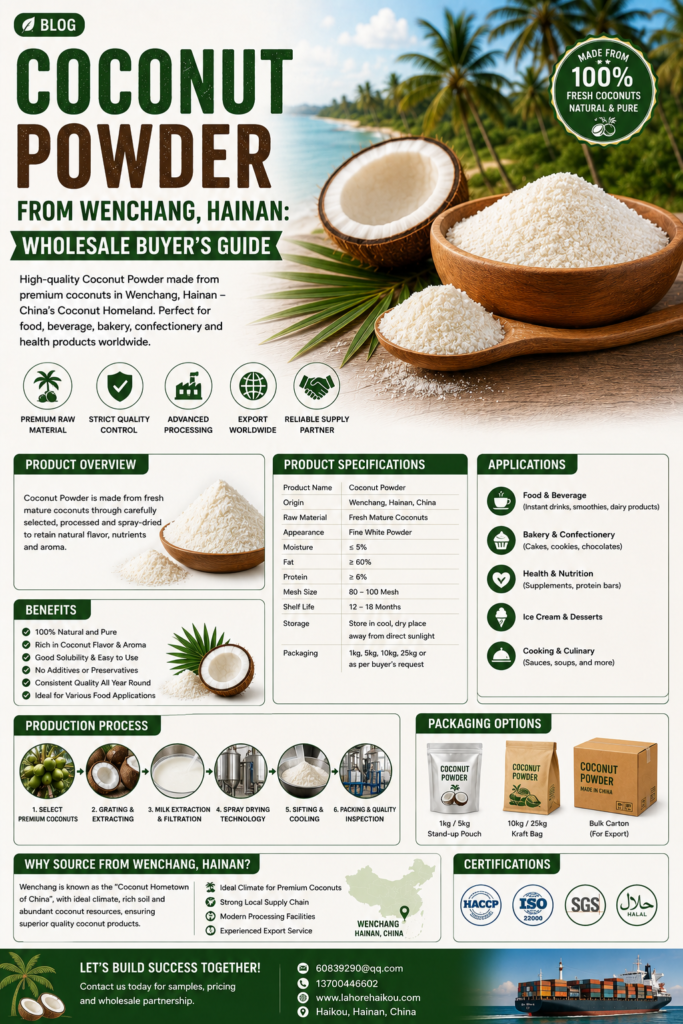
For international buyers interested in sourcing coconut products from China, Wenchang, Hainan is a location worth exploring because of its strong connection with coconut cultivation and processing.
However, the term coconut powder can refer to different products. It may describe spray-dried coconut milk powder, coconut cream powder, finely processed coconut kernel powder, or other coconut-based powdered ingredients. These products have different compositions, applications, and specifications.
For wholesale buyers, identifying the exact product you need is the first step toward finding the right supplier.
This guide explains how to source coconut powder from Wenchang, Hainan, what specifications to check, how to compare suppliers, and what international buyers should consider before placing a bulk order.
What Is Coconut Powder?
Coconut powder is a dried coconut-based ingredient that can be produced from coconut milk, coconut cream, or processed coconut kernel, depending on the product.
Spray-dried coconut milk powder is produced by removing water from coconut milk and is designed to be easily dispersed or reconstituted with water.
Other coconut powders may be made by drying and grinding coconut material.
Because different products are sold under similar names, buyers should always ask:
“What exactly is the raw material and production process used to make this coconut powder?”
This question can prevent misunderstandings when comparing suppliers.
Why Source Coconut Powder from Wenchang?
Wenchang is one of the areas in Hainan closely associated with coconut cultivation.
The wider Hainan coconut industry supports a range of products, including:
- Coconut milk
- Coconut oil
- Coconut water
- Coconut candy
- Coconut cream
- Desiccated coconut
- Coconut powder
- Coconut shell products
- Coir fiber
- Coco peat
For international buyers, Wenchang can therefore be an interesting location when looking for coconut-related suppliers and processors.
However, buyers should evaluate each supplier independently. Not every company will manufacture every type of coconut powder or have the same production capacity and export experience.
Different Types of Coconut Powder
Before requesting a wholesale quotation, determine which type of powder you actually need.
1. Coconut Milk Powder
Coconut milk powder is generally produced by drying coconut milk, commonly through spray drying.
It can be reconstituted with water and used in food applications.
It is commonly used in:
- Curries
- Soups
- Sauces
- Beverages
- Desserts
- Instant food mixes
- Bakery products
- Food-service products
2. Coconut Cream Powder
Coconut cream powder is generally formulated to provide a richer coconut profile and can be used where additional coconut fat and creaminess are desired.
Potential applications include:
- Desserts
- Sauces
- Ice cream
- Beverage mixes
- Bakery products
- Confectionery
3. Desiccated Coconut Powder
This type is made from dried coconut kernel and processed into a powder or fine particle format.
It can be used in:
- Bakery
- Cookies
- Cakes
- Chocolate
- Confectionery
- Snack products
Desiccated coconut is commonly used in confectionery and baked foods.
4. Coconut Flour
Coconut flour is a different product and should not automatically be treated as coconut milk powder.
It is commonly used in:
- Baking
- Gluten-free products
- High-fiber formulations
- Food mixes
If you require coconut flour, state this clearly in your RFQ.
Coconut Powder Applications
Wholesale coconut powder can be used across many industries.
Bakery
Manufacturers can use coconut powder in:
- Cakes
- Cookies
- Biscuits
- Muffins
- Pastries
- Bakery fillings
Confectionery
Applications include:
- Coconut candy
- Chocolate
- Truffles
- Bars
- Coconut fillings
Beverages
Coconut milk powder can be used in:
- Instant coconut beverages
- Smoothies
- Coffee products
- Beverage mixes
- Plant-based drink formulations
Sauces and Curries
Coconut milk powder can provide coconut flavor, body, and creaminess in dry or liquid food formulations.
Desserts
Potential applications include:
- Ice cream
- Puddings
- Custards
- Dessert mixes
- Frozen desserts
Instant Food
Powdered coconut ingredients can be convenient for manufacturers producing dry mixes and instant foods.
The dry format can simplify storage, handling, transportation, and dosing compared with liquid coconut milk.
Important Specifications for Wholesale Buyers
When purchasing coconut powder in bulk, price should not be your first question.
First define the technical specification.
Important parameters may include:
- Product type
- Coconut source
- Coconut content
- Fat percentage
- Moisture
- Protein
- Ash
- Particle size
- Bulk density
- Solubility
- Dispersibility
- Flavor
- Color
- Microbiological limits
- Shelf life
- Storage conditions
The exact specification depends on the type of coconut powder and its intended application.
Fat Content
Fat content can significantly affect how coconut powder performs in food manufacturing.
For example, a manufacturer making a rich coconut beverage may require a different powder from a bakery company looking primarily for coconut flavor.
Some standards for coconut milk powder specify minimum fat levels. For example, India’s FSSAI standard for coconut milk powder specifies at least 60% fat on a dry basis, along with other requirements.
This does not mean that every coconut powder sold internationally must meet that exact specification.
Instead, it demonstrates why buyers should specify the required fat level according to their destination market and application.
Moisture Content
Moisture is another important quality parameter.
Excess moisture can affect:
- Powder flow
- Clumping
- Shelf stability
- Storage
- Microbiological quality
As an example, the FSSAI coconut milk powder standard specifies a maximum moisture level of 2.5%.
Your own specification should be based on the product type, supplier specification, applicable standards, and intended market.
Particle Size and Solubility
Particle size can influence how the powder behaves during production.
Depending on the application, you may require:
- Fine powder
- Standard powder
- Instant powder
- Agglomerated powder
If your product needs rapid reconstitution, ask the supplier for information about:
- Solubility
- Dispersibility
- Particle size
- Reconstitution ratio
A powder suitable for bakery production may not be ideal for an instant beverage.
Ingredients and Carriers
One of the most important questions for buyers is:
“Is this 100% coconut powder, or does it contain carriers or other ingredients?”
Some spray-dried coconut milk powders use carriers or processing aids because coconut fat can make spray drying and powder handling challenging. Tetra Pak’s coconut-processing reference describes the use of maltodextrin and casein-based ingredients in conventional spray-drying processes.
Depending on the formulation, a commercial product may contain ingredients such as:
- Coconut milk
- Coconut cream
- Maltodextrin
- Sodium caseinate
- Lecithin
- Other permitted processing or functional ingredients
Always request the complete ingredient declaration.
Vegan and Dairy-Free Requirements
If your target market requires a vegan or dairy-free product, carefully check the ingredient list.
Some coconut milk powders may use sodium caseinate, which is derived from milk.
Therefore, do not assume that every product labeled “coconut milk powder” is automatically vegan or dairy-free.
Ask the supplier for:
- Complete ingredient list
- Allergen declaration
- Vegan statement, if available
- Dairy-free statement, if applicable
- Manufacturing cross-contact information
This is particularly important for international retail products.
Food Safety and Certifications
Wholesale food buyers should evaluate the supplier’s food-safety systems.
Depending on your market and customer requirements, relevant certifications may include:
- HACCP
- ISO 22000
- FSSC 22000
- BRCGS
- Halal
- Kosher
- Organic certification
Not every certification is required for every product or country.
The important point is to confirm that the supplier’s certification is:
- Current
- Issued by an appropriate certification body
- Applicable to the manufacturing facility
- Applicable to the product you are purchasing
Request a Certificate of Analysis
A Certificate of Analysis (COA) is an important document for wholesale buyers.
Depending on the product, the COA may include:
- Moisture
- Fat
- Protein
- Ash
- Microbiological results
- Particle size
- Other technical parameters
For larger or repeated orders, buyers may also consider independent laboratory testing.
The specification agreed in your purchase contract should match the quality requirements you actually need.
Request Samples Before Buying in Bulk
A sample is one of the most useful tools for evaluating a coconut powder supplier.
Test the sample for:
Appearance
Check:
- Color
- Uniformity
- Powder flow
- Clumping
Aroma
The product should have the expected coconut aroma for its grade.
Taste
Check coconut intensity and any undesirable flavors.
Reconstitution
If buying coconut milk powder, test the powder with water according to the supplier’s recommended ratio.
Production Performance
If you are a food manufacturer, test the ingredient in your actual recipe.
A powder that performs well in a simple laboratory test may behave differently in commercial production.
Packaging for Bulk Coconut Powder
Wholesale coconut powder can be supplied in different packaging formats.
Common options may include:
- 10 kg bags
- 20 kg bags
- 25 kg bags
- Food-grade kraft bags with inner liners
- Plastic-lined bags
- Cartons
- Customized export packaging
The actual options depend on the supplier.
Ask for:
- Net weight
- Gross weight
- Bag dimensions
- Pallet configuration
- Number of bags per pallet
- Container loading quantity
Packaging should protect the powder from moisture and contamination during storage and transportation.
Private-Label Coconut Powder
International brands may also consider private-label coconut powder.
A supplier may potentially provide:
- Custom packaging
- Custom labels
- Different package sizes
- Retail-ready products
- Customized formulations
Private-label projects generally require more planning than standard bulk purchases.
Discuss:
- MOQ
- Packaging costs
- Label artwork
- Product formulation
- Certification
- Production lead time
- Packaging materials
Minimum Order Quantity
MOQ varies from supplier to supplier.
It can depend on:
- Product type
- Packaging
- Private label
- Custom formulation
- Production schedule
- Order volume
If you are testing the market, ask whether the supplier can provide a smaller trial quantity.
Once the product has been approved, you can negotiate larger production volumes.
How to Compare Wholesale Suppliers
Do not choose a supplier simply because they offer the lowest price.
Use a structured comparison.
| Factor | What to Check |
|---|---|
| Product type | Milk powder, cream powder, kernel powder, etc. |
| Coconut content | Exact specification |
| Fat | Required percentage |
| Moisture | Maximum level |
| Ingredients | Carriers and additives |
| Solubility | Suitable for application |
| Particle size | Required specification |
| Certifications | Relevant market requirements |
| MOQ | Minimum order |
| Packaging | Bulk/export format |
| Shelf life | Required period |
| Production capacity | Monthly capacity |
| Lead time | Sample and production |
| COA | Available for each batch |
| Export experience | Destination markets |
| Price | Compare identical specifications |
This approach makes supplier comparison much more reliable.
How to Request a Wholesale Quotation
A professional RFQ should contain enough information for the supplier to provide an accurate quotation.
For example:
Product: Coconut Milk Powder
Application: Beverage / Bakery / Sauce
Required Fat: [Your specification]
Quantity: 5 metric tons
Packaging: 25 kg food-grade bags
Certifications: [Required certifications]
Private Label: No
Target Market: [Country]
Destination Port: [Port]
Trade Term: FOB / CIF
Ask the supplier to provide:
- Price per kg
- MOQ
- Product specification
- Ingredient list
- COA
- Certifications
- Sample availability
- Packaging details
- Shelf life
- Storage requirements
- Production lead time
- Export documentation
- Payment terms
Exporting Coconut Powder from Hainan
International buyers should understand that exporting food ingredients involves both supplier-side and destination-country requirements.
Depending on the product and destination, buyers may need to consider:
- Customs classification
- Food-import regulations
- Product labeling
- Ingredient declarations
- Allergen requirements
- Certificate of Origin
- Commercial invoice
- Packing list
- Bill of lading
- Certificate of Analysis
- Food-safety documentation
The exact requirements vary by country.
Before ordering, check the import regulations in your destination market.
Shipping and Storage
One of the major advantages of powdered coconut ingredients is the convenience of handling and storage compared with liquid coconut products.
However, the powder still needs suitable storage.
Ask the supplier for:
- Recommended temperature
- Recommended humidity
- Shelf life
- Packaging requirements
- Storage conditions after opening
Keep the product protected from:
- Moisture
- Excessive heat
- Direct sunlight
- Contamination
Follow the supplier’s storage instructions and the requirements of your destination market.
Coconut Powder vs. Liquid Coconut Milk
For some manufacturers, powdered coconut ingredients can simplify logistics.
| Feature | Coconut Powder | Liquid Coconut Milk |
|---|---|---|
| Storage | Dry storage | Product-dependent |
| Transportation | Generally easier to handle | Heavier due to water content |
| Shelf life | Product-dependent | Product-dependent |
| Dosing | Convenient for dry mixes | Requires liquid handling |
| Applications | Dry mixes and food production | Direct cooking and beverages |
| Reconstitution | Requires water | Ready-to-use |
The best option depends on your production process and finished product.
Questions to Ask a Wenchang Coconut Powder Supplier
Before placing an order, ask:
- Are you the manufacturer or trading company?
- Where is your production facility?
- What type of coconut powder do you manufacture?
- Is it coconut milk powder, coconut cream powder, or coconut kernel powder?
- What is the coconut content?
- What is the fat percentage?
- What is the moisture level?
- What ingredients or carriers are used?
- Is sodium caseinate included?
- Is the product vegan or dairy-free?
- Can you provide a full ingredient declaration?
- Can you provide a COA?
- What certifications do you have?
- What is the MOQ?
- Can you provide samples?
- What packaging options are available?
- What is the shelf life?
- What are the storage requirements?
- What is your monthly production capacity?
- Do you have export experience?
- What is the production lead time?
- What export documents can you provide?
Common Mistakes When Buying Coconut Powder
Buying Without Defining the Product
“Coconut powder” can mean different things.
Specify exactly what you need.
Comparing Prices Without Comparing Specifications
A lower-priced powder may have a different fat level, carrier system, or coconut content.
Assuming Coconut Powder Is 100% Coconut
Check the ingredient list.
Ignoring Allergen Information
Some formulations may contain dairy-derived ingredients.
Ordering Without a Sample
Always test the product before making a large commitment.
Ignoring Moisture and Storage
Powders can absorb moisture and develop quality problems if stored incorrectly.
Forgetting Import Regulations
Check your country’s requirements before ordering.
Paying Without Supplier Verification
Conduct appropriate supplier due diligence before making a substantial payment.
A Step-by-Step Wholesale Sourcing Process
Step 1 — Define Your Product
Determine:
- Product type
- Application
- Fat content
- Ingredients
- Packaging
- Quantity
Step 2 — Identify Suppliers
Research coconut powder manufacturers and suppliers in Wenchang and other suitable areas of Hainan or China.
Step 3 — Request Technical Specifications
Ask for the complete product specification and ingredient declaration.
Step 4 — Request Samples
Test the product in your intended application.
Step 5 — Compare Suppliers
Compare quality, specifications, certifications, MOQ, price, capacity, and lead time.
Step 6 — Verify the Supplier
Check company information, manufacturing capability, certifications, and export experience.
Step 7 — Confirm the Commercial Terms
Agree on:
- Price
- Quantity
- Packaging
- Payment
- Lead time
- Incoterms
Step 8 — Conduct Quality Control
Consider third-party inspection or laboratory testing for significant orders.
Step 9 — Arrange Shipping
Coordinate freight, export documentation, customs, and destination delivery.
Step 10 — Inspect Upon Arrival
Verify the product against the agreed specification.
Why Work with a Local China Sourcing Partner?
International buyers may find it difficult to communicate with suppliers, compare Chinese-language documents, inspect factories, or coordinate samples.
A local sourcing partner can potentially assist with:
- Supplier research
- Chinese-language communication
- Supplier verification
- Price negotiation
- Sample collection
- Product specifications
- Factory communication
- Quality inspection
- Packaging
- Logistics
- Export coordination
For first-time buyers, local assistance can make the sourcing process more manageable.
Final Thoughts
Coconut powder from Wenchang, Hainan can be an interesting ingredient-sourcing opportunity for international food manufacturers, wholesalers, distributors, bakeries, beverage companies, confectionery businesses, restaurants, and private-label brands.
The most important step is to identify exactly which type of coconut powder you need.
Before placing a wholesale order, evaluate the raw material, production method, coconut content, fat percentage, moisture, particle size, solubility, ingredients, carriers, allergen status, certifications, packaging, shelf life, MOQ, production capacity, and export documentation.
Request samples and a Certificate of Analysis, test the powder in your intended application, verify the supplier, and check the food-import regulations of your target market.
With a clear specification and careful supplier evaluation, Wenchang can be a useful starting point for exploring coconut-product sourcing opportunities in Hainan.
START YOUR CHINA SOURCING JOURNEY TODAY
📱 13700446602
📍 Haikou, Hainan, China
Looking for Coconut Products from Wenchang?
We can help international buyers explore sourcing opportunities for:
- Coconut Powder
- Coconut Milk Powder
- Coconut Cream Powder
- Coconut Milk
- Coconut Oil
- Coconut Water
- Traditional Coconut Candy
- Desiccated Coconut
- Coconut Shell Charcoal
- Coconut Shell Powder
- Coir Fiber
- Coco Peat
Send us your product specification, required quantity, packaging requirements, target market, and destination to discuss your sourcing requirements.
Source from Hainan. Connect with Chinese suppliers. Build your international business.