Coconut milk is widely used in food and beverage manufacturing, restaurants, bakeries, sauces, desserts, ready-to-eat meals, and many other applications. For international buyers looking for coconut-based ingredients from China, Wenchang, Hainan is an interesting location to explore because of its strong connection with coconut cultivation and processing.
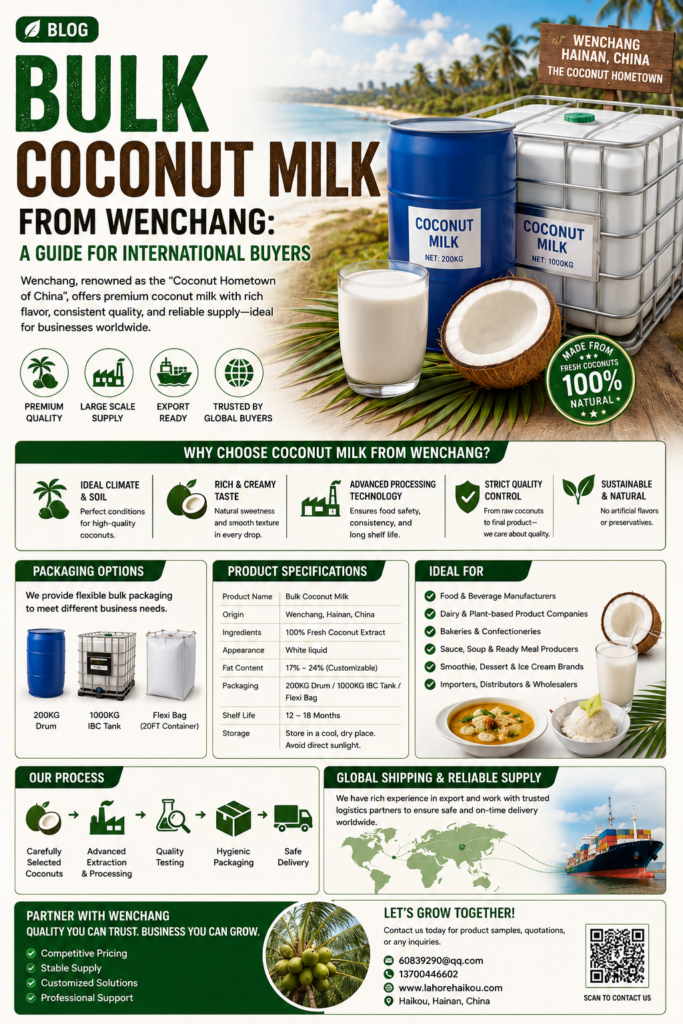
Buying coconut milk in bulk requires more than simply finding a supplier and requesting a price. International buyers should evaluate the product specification, coconut content, processing method, packaging, shelf life, certifications, production capacity, shipping requirements, and import regulations in the destination market.
This guide explains what international buyers should consider when sourcing bulk coconut milk from Wenchang, Hainan, China.
Why Source Coconut Milk from Wenchang?
Wenchang is located in northeastern Hainan and is closely associated with Hainan’s coconut-growing industry.
The region has a long history of coconut cultivation, and coconut products are an important part of the local agricultural and food-processing ecosystem.
For international buyers, sourcing from Wenchang may provide opportunities to explore:
- Coconut milk
- Coconut cream
- Coconut water
- Coconut oil
- Desiccated coconut
- Coconut powder
- Coconut snacks
- Coconut candy
- Coconut-based ingredients
- Other coconut by-products
However, buyers should evaluate individual suppliers carefully because production capabilities and product specifications can vary.
What Is Coconut Milk?
Coconut milk is a liquid product made by processing coconut flesh with water.
It is commonly used in:
- Asian cuisine
- Curries
- Soups
- Sauces
- Desserts
- Beverages
- Bakery products
- Ice cream
- Ready meals
- Plant-based food products
The final characteristics of coconut milk can vary considerably depending on the coconut material, extraction process, water ratio, homogenization, heat treatment, and formulation.
For this reason, buyers should always request a detailed product specification before placing a bulk order.
Bulk Coconut Milk vs. Retail Coconut Milk
International buyers should distinguish between bulk coconut milk and retail packaged coconut milk.
Bulk products are generally intended for:
- Food manufacturers
- Restaurant groups
- Beverage manufacturers
- Ingredient distributors
- Private-label brands
- Wholesalers
- Food-service companies
Bulk coconut milk may be supplied in different packaging formats depending on the supplier and application.
Possible formats can include:
- Aseptic bags
- Bag-in-box packaging
- Food-grade drums
- Large food-service containers
- Cans
- Other industrial packaging
The best packaging depends on your production process, storage facilities, transportation requirements, and target market.
What Should International Buyers Check?
When requesting quotations from coconut milk suppliers in Wenchang, ask for detailed information about the product.
Important specifications can include:
Coconut Content
Ask for the coconut content or coconut extract percentage.
Different products may have different formulations, so comparing prices without comparing specifications can be misleading.
Fat Content
Fat content can significantly affect:
- Taste
- Texture
- Creaminess
- Cooking performance
- Food formulation
Ask the supplier for the exact specification.
Ingredients
Request a complete ingredient list.
Some coconut milk products may contain ingredients such as:
- Coconut extract
- Water
- Stabilizers
- Emulsifiers
- Salt
- Sugar
Do not assume that every coconut milk product contains only coconut and water.
Processing Method
Ask how the product is processed and preserved.
Possible processes can include:
- Pasteurization
- UHT processing
- Aseptic processing
- Other commercial heat-treatment methods
The processing method can affect shelf life, flavor, storage requirements, and shipping.
Request a Product Specification Sheet
Before ordering bulk coconut milk, request a formal product specification.
The specification should ideally include:
- Product name
- Ingredients
- Coconut content
- Fat percentage
- Appearance
- Color
- Flavor
- Odor
- pH
- Viscosity, where relevant
- Microbiological specifications
- Shelf life
- Storage conditions
- Packaging information
- Net weight
- Country of origin
A clear specification makes it easier to compare suppliers.
Ask for Samples Before Bulk Orders
Never rely only on photographs or a supplier’s product description.
Request samples before committing to a large order.
Evaluate:
- Taste
- Aroma
- Color
- Texture
- Thickness
- Coconut flavor
- Separation
- Cooking performance
- Packaging condition
If the product will be used in manufacturing, test it in your actual production process.
A coconut milk product that tastes good by itself may perform differently when used in sauces, beverages, desserts, or other food products.
Laboratory Testing and Quality Control
For larger commercial orders, buyers may consider independent product testing.
Depending on the destination market and product requirements, testing may cover areas such as:
- Microbiological safety
- Chemical parameters
- Heavy metals
- Pesticide residues
- Allergens
- Additives
- Nutritional composition
The exact testing requirements depend on the destination country and intended application.
For high-volume purchases, consider establishing a quality-control process before shipment.
Food Safety Certifications
International buyers should ask suppliers what food-safety systems and certifications they maintain.
Depending on the supplier and destination market, relevant certifications may include:
- HACCP
- ISO 22000
- BRCGS
- FSSC 22000
- Halal
- Kosher
- Organic certification
Not every certification is necessary for every buyer.
The important point is to verify whether the supplier’s certifications meet the requirements of your target market and customers.
Always request copies of certificates and verify that they are current and applicable to the manufacturing facility and product.
Shelf Life and Storage
Shelf life is an important consideration when importing coconut milk.
Ask the supplier:
- What is the shelf life?
- What storage temperature is required?
- Does the product require refrigeration?
- What is the recommended transportation temperature?
- How is the product preserved?
- What happens after opening?
A shelf-stable product may be easier and less expensive to transport than a product requiring refrigerated logistics.
However, storage requirements depend on the specific product and processing method.
Packaging Options for Bulk Buyers
Packaging should be selected according to your business model.
Aseptic Packaging
Aseptic packaging can be suitable for certain shelf-stable liquid food products and may offer logistical advantages.
Bag-in-Box
Bag-in-box packaging can be useful for food-service and manufacturing applications.
Cans
Canned coconut milk is widely used for retail and food-service applications.
Drums or Industrial Containers
Larger containers may be considered by food manufacturers purchasing high volumes.
The supplier should provide details about:
- Container size
- Net weight
- Gross weight
- Dimensions
- Pallet configuration
- Carton configuration
- Loading quantity
Private Label Coconut Milk from Wenchang
International brands may also explore private-label coconut milk.
Under a private-label arrangement, a manufacturer produces the product according to the buyer’s specifications and packaging requirements.
Potential private-label services can include:
- Custom packaging
- Custom labels
- Brand development
- Product formulation
- Different package sizes
- Retail packaging
- Food-service packaging
Before starting a private-label project, confirm minimum order quantities, packaging costs, artwork requirements, lead time, and certification requirements.
Minimum Order Quantity
Minimum order quantity, or MOQ, varies from supplier to supplier.
A supplier may offer different MOQs depending on:
- Standard product
- Custom formulation
- Private label
- Packaging type
- Container size
- Production schedule
If you are a new buyer, ask whether a smaller trial order is available before moving to full-container quantities.
How to Compare Coconut Milk Suppliers
Do not select a supplier based solely on the lowest price.
Compare suppliers based on:
| Factor | What to Check |
|---|---|
| Product specification | Coconut content, fat, ingredients |
| Quality | Samples and testing |
| Certifications | Relevant food-safety certificates |
| MOQ | Minimum order requirement |
| Price | Product + packaging + logistics |
| Packaging | Format and size |
| Shelf life | Remaining shelf life at shipment |
| Production capacity | Ability to supply consistently |
| Lead time | Production and delivery schedule |
| Documentation | COA and export documents |
| Communication | Response speed and clarity |
| Customization | Private-label options |
A reliable supplier should be able to provide clear and consistent information.
How to Request a Coconut Milk Quotation
When contacting suppliers, provide detailed requirements.
For example:
Product: Coconut Milk
Quantity: 1 × 20-foot container
Packaging: Industrial food-grade packaging
Coconut content: Specify required percentage
Target market: [Your country]
Private label: Yes/No
Required certifications: [List]
Delivery: FOB/CIF/DDP or another agreed term
Destination port: [Port]
Ask the supplier to quote:
- Product price
- Packaging cost
- MOQ
- Production lead time
- Port of loading
- Payment terms
- Sample availability
- Certification costs
- Shipping options
This makes supplier quotations easier to compare.
FOB, CIF and Other Shipping Terms
International buyers should understand the quotation terms.
FOB
The supplier generally handles the goods until loading onto the vessel at the agreed port, while the buyer manages the main international freight and subsequent costs.
CIF
The seller generally arranges the goods, insurance, and freight to the named destination port.
EXW
The buyer generally takes responsibility from the supplier’s premises.
DDP
The seller takes responsibility for delivery to the agreed destination, including duties and taxes where applicable, subject to the specific arrangement and legal requirements.
Always clarify exactly what is included in a supplier’s quotation.
Shipping Coconut Milk Internationally
Coconut milk is a food product, so shipping requirements depend heavily on the formulation and packaging.
Before shipping, confirm:
- Product shelf life
- Storage temperature
- Container requirements
- Packaging strength
- Shipping conditions
- Customs documentation
- Import requirements
- Destination-country food regulations
Your freight forwarder and customs broker can help determine the appropriate shipping arrangements.
Import Regulations
International buyers should check the regulations in their own country before placing a large order.
Potential requirements can include:
- Food-import registration
- Product labeling
- Ingredient declarations
- Nutrition information
- Allergen declarations
- Country-of-origin information
- Food-safety documentation
- Import permits
- Customs documentation
Requirements vary by country.
Do not assume that a product legally sold in China can automatically be imported and sold in another country.
Coconut Milk Labeling
If you plan to sell coconut milk under your own brand, check your destination market’s labeling requirements.
Labels may need information such as:
- Product name
- Ingredients
- Nutrition information
- Net quantity
- Manufacturer
- Country of origin
- Batch number
- Production date
- Expiry or best-before date
- Storage instructions
- Importer information
The exact requirements depend on the destination country.
Building a Long-Term Supplier Relationship
For regular buyers, building a long-term relationship with a reliable supplier can provide advantages.
Once a supplier has passed your quality requirements, you can establish agreed standards for:
- Product specification
- Packaging
- Quality control
- Production schedule
- Pricing
- Documentation
- Shipping
- Complaint handling
For repeat orders, maintaining the same product specification is particularly important.
Common Mistakes When Buying Bulk Coconut Milk
Choosing Only by Price
The cheapest quotation may not provide the specification you need.
Ordering Without a Sample
Always evaluate the product before committing to a large order.
Ignoring Coconut Content
Different formulations can have very different commercial value.
Forgetting Shelf Life
Make sure sufficient shelf life remains when the product arrives at its destination.
Not Checking Import Regulations
Confirm destination-country requirements before ordering.
Paying Before Supplier Verification
Conduct appropriate supplier due diligence before making significant payments.
Not Inspecting the Final Shipment
For large orders, consider appropriate pre-shipment quality checks.
Questions to Ask a Wenchang Coconut Milk Supplier
Before placing an order, ask:
- What is the coconut content?
- What is the fat percentage?
- What are the ingredients?
- What processing method is used?
- What is the shelf life?
- What storage conditions are required?
- What packaging options are available?
- What is the MOQ?
- Can you provide samples?
- Can you provide a product specification sheet?
- Can you provide a Certificate of Analysis?
- What food-safety certifications do you have?
- Can you provide private-label packaging?
- What is the production lead time?
- What export documents can you provide?
- Which port will the goods ship from?
- What payment terms are available?
- Can you arrange third-party inspection?
A Practical Buying Process
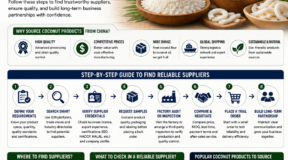
A professional sourcing process can follow these steps:
Step 1 — Define Your Requirements
Decide your product specification, quantity, packaging, destination, and certifications.
Step 2 — Find Potential Suppliers
Research coconut milk manufacturers and suppliers in Wenchang and other suitable locations in Hainan or China.
Step 3 — Request Quotations
Send the same specification to multiple suppliers.
Step 4 — Compare Specifications
Compare coconut content, fat, ingredients, packaging, MOQ, and shelf life.
Step 5 — Request Samples
Test the samples before making a large commitment.
Step 6 — Verify the Supplier
Check the company’s business information, manufacturing capability, certifications, and export experience.
Step 7 — Confirm the Order
Finalize the specification, quantity, packaging, price, payment terms, and delivery terms.
Step 8 — Conduct Quality Control
For larger orders, consider pre-production, during-production, or pre-shipment inspection.
Step 9 — Arrange Shipping
Coordinate freight, customs documentation, and destination-country import requirements.
Step 10 — Inspect Upon Arrival
Check the shipment against the agreed specifications when it arrives.
Why Work with a China-Based Sourcing Partner?
International buyers who are unfamiliar with Chinese suppliers may benefit from local sourcing support.
A sourcing partner can potentially help with:
- Supplier identification
- Chinese-language communication
- Factory communication
- Price negotiation
- Sample coordination
- Product specification
- Quality inspection
- Packaging
- Shipping coordination
- Export documentation
The buyer should still approve the final product specifications and commercial terms.
Final Thoughts
Bulk coconut milk from Wenchang, Hainan can be an interesting sourcing opportunity for international food manufacturers, wholesalers, distributors, restaurants, and private-label brands.
However, successful sourcing requires more than finding a low price.
International buyers should compare coconut content, fat percentage, ingredients, processing method, packaging, shelf life, certifications, MOQ, production capacity, documentation, and shipping requirements.
The best approach is to define your specifications first, request samples, verify suppliers, check destination-country regulations, and establish clear quality standards before placing a large order.
If you are planning to source coconut milk or other coconut products from Wenchang, working with experienced local sourcing and business-support professionals can make supplier communication and purchasing coordination easier.
START YOUR CHINA SOURCING JOURNEY TODAY
📱 13700446602
📍 Haikou, Hainan, China
Looking for Coconut Products from Wenchang?
We can help international buyers explore sourcing opportunities for:
- Coconut Milk
- Coconut Cream
- Coconut Oil
- Coconut Water
- Coconut Candy
- Desiccated Coconut
- Coconut Powder
- Coconut Shell Charcoal
- Coconut Shell Powder
- Coir Fiber
- Coco Peat
- Other Coconut Products
Send us your product specifications, required quantity, packaging requirements, target market, and delivery destination to discuss your sourcing requirements.
Source from China. Connect with suppliers. Build your international business.