Wenchang, Hainan, is well known for its coconut-growing tradition and distinctive coconut-based foods. Among the region’s traditional products, coconut candy is an interesting product for international buyers looking for authentic Hainan food products with a tropical identity.
Traditional coconut candy can be made using coconut meat, coconut milk, coconut cream, sugar, and other ingredients depending on the recipe and production method. The finished product can range from soft and chewy coconut sweets to firmer candies and individually wrapped confectionery products.
For international buyers, sourcing coconut candy from Wenchang can offer opportunities in wholesale distribution, specialty food stores, Asian grocery markets, gift products, tourism retail, private labeling, and international e-commerce.
This guide explains the characteristics of traditional coconut candy, how it is produced, what buyers should consider when sourcing it, and the important steps involved in exporting coconut candy from Hainan, China.
What Is Traditional Coconut Candy?
Traditional coconut candy is a confectionery product made primarily from coconut-based ingredients.
Depending on the manufacturer and recipe, ingredients may include:
- Coconut meat
- Coconut milk
- Coconut cream
- Coconut powder
- Sugar
- Glucose syrup
- Milk ingredients
- Flavoring ingredients
- Other permitted food ingredients
Different manufacturers may use different recipes and production techniques.
The texture can also vary from soft and chewy to firm and slightly crunchy.
For international buyers, it is important to request the manufacturer’s complete ingredient list and product specification before placing an order.
Why Wenchang Is Associated With Coconut Products
Wenchang is one of the best-known coconut-producing areas in Hainan.
Coconut cultivation has an important place in the region’s agricultural and food culture, and coconut is used in many local foods and beverages.
The availability of coconut-related raw materials makes Wenchang an interesting location for buyers researching products such as:
- Coconut candy
- Coconut milk
- Coconut oil
- Coconut powder
- Coconut flour
- Coconut water
- Desiccated coconut
- Coconut snacks
- Coconut-based desserts
- Coconut shell products
- Coir fiber
- Coco peat
For international buyers, this broader coconut ecosystem can make the region worth exploring when developing a coconut-product portfolio.
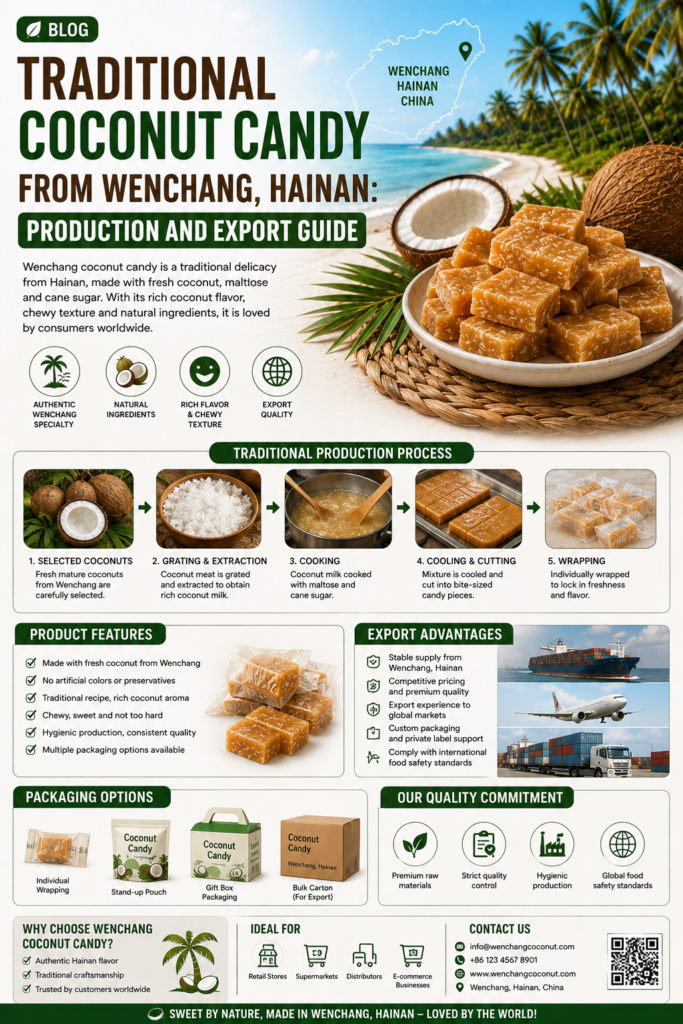
Traditional Coconut Candy Production Process
The exact production method varies between manufacturers, but a typical coconut candy production process may involve several stages.
Step 1: Selecting Coconut Ingredients
Manufacturers begin by selecting suitable coconut raw materials.
Depending on the product, these may include fresh coconut meat, coconut milk, coconut cream, or processed coconut ingredients.
Quality raw materials are important because they influence:
- Flavor
- Aroma
- Texture
- Color
- Shelf life
- Overall product quality
Step 2: Preparing the Coconut
If fresh coconut is used, the coconut may be opened, cleaned, and processed to obtain the required coconut meat or coconut liquid.
The coconut material may then be grated, blended, extracted, or otherwise processed according to the recipe.
Step 3: Mixing the Ingredients
The coconut ingredients are combined with sugar and other ingredients specified in the formulation.
The proportions depend on the manufacturer’s recipe and the desired characteristics of the finished candy.
Manufacturers may develop different formulations for:
- Soft coconut candy
- Chewy coconut candy
- Coconut milk candy
- Coconut cream candy
- Coconut-flavored confectionery
Step 4: Heating and Cooking
The mixture is heated under controlled conditions.
Cooking helps reduce moisture and allows the ingredients to develop the desired consistency.
Temperature and cooking time can have a significant effect on the final texture.
Step 5: Achieving the Desired Texture
The cooked mixture is processed until it reaches the required consistency.
Depending on the product, the manufacturer may aim for:
- Soft texture
- Chewy texture
- Firm texture
- Creamy texture
Manufacturers use their own production parameters to achieve consistent results.
Step 6: Cooling
After cooking, the coconut candy mixture is allowed to cool.
Cooling helps the product reach its final texture before cutting or forming.
Step 7: Cutting and Forming
Once the product reaches the appropriate consistency, it can be cut or formed into individual pieces.
Common formats include:
- Small cubes
- Rectangular pieces
- Round pieces
- Bars
- Individually wrapped pieces
The format can be customized depending on the target market.
Step 8: Packaging
Packaging is an important part of commercial coconut candy production.
Common packaging options include:
- Individual wrappers
- Plastic bags
- Pouches
- Boxes
- Gift packaging
- Bulk cartons
International buyers should select packaging based on the destination market, transportation conditions, shelf-life requirements, and retail strategy.
Types of Coconut Candy Buyers Can Source
International buyers may find several types of coconut candy in the market.
Soft Coconut Candy
Soft coconut candy generally has a softer, chewy texture and strong coconut flavor.
Chewy Coconut Candy
Chewy varieties can be produced with a firmer texture and are often individually wrapped for retail sale.
Coconut Milk Candy
Some products use coconut milk or coconut cream as a major ingredient.
Coconut Powder Candy
Coconut powder may be incorporated into certain confectionery formulations.
Coconut-Flavored Candy
Some products may use coconut flavoring rather than relying primarily on fresh coconut ingredients.
Buyers should distinguish between products made with real coconut ingredients and products that mainly use coconut flavoring.
What Makes Coconut Candy Attractive to International Buyers?
Coconut candy has several characteristics that can make it suitable for international markets.
Tropical Product Identity
Coconut is strongly associated with tropical regions, making coconut-based products attractive as specialty foods.
Convenient Packaging
Individually wrapped coconut candies can be convenient for retail stores, hotels, gift shops, and travel-related businesses.
Long-Distance Distribution
Depending on the formulation and packaging, commercially produced candy may be suitable for distribution over longer distances.
Buyers should always confirm the manufacturer’s stated shelf life and storage requirements.
Private-Label Potential
Some manufacturers may offer customized packaging or private-label production.
This can allow an international buyer to sell coconut candy under its own brand.
Private-Label Coconut Candy from China
Private labeling can be an interesting option for importers who want to develop their own coconut candy brand.
A typical private-label project may involve:
- Selecting the product
- Choosing the manufacturer
- Reviewing the recipe
- Requesting samples
- Testing the product
- Designing packaging
- Confirming labeling requirements
- Approving the final sample
- Placing the production order
- Completing quality inspection
- Arranging export logistics
Private-label buyers should confirm minimum order quantities, packaging options, production lead times, and customization costs before placing an order.
How to Find Coconut Candy Suppliers in Wenchang
Finding a suitable supplier is one of the most important parts of the sourcing process.
International buyers can research manufacturers through:
- Local business networks
- Food-processing companies
- Chinese B2B platforms
- Trade exhibitions
- Sourcing companies
- Local industry contacts
- Direct factory communication
When contacting a supplier, provide detailed information about your requirements.
For example:
- Product type
- Ingredients
- Target weight
- Packaging format
- Quantity
- Destination country
- Private-label requirements
- Expected delivery schedule
Clear specifications make it easier for suppliers to provide accurate quotations.
What to Ask a Coconut Candy Supplier
Before placing an order, international buyers should ask the supplier for relevant information.
Important questions include:
- What are the ingredients?
- Does the product contain real coconut?
- What is the net weight per piece?
- What is the shelf life?
- What are the storage conditions?
- What is the minimum order quantity?
- What packaging options are available?
- Can the packaging be customized?
- What certifications are available?
- Can the supplier provide product specifications?
- Can the supplier provide samples?
- What is the production lead time?
- What export documents can be provided?
- What are the shipping options?
The answers can help buyers compare different suppliers.
Quality Control for Coconut Candy
Quality control is important when purchasing food products internationally.
Buyers should evaluate:
- Taste
- Aroma
- Texture
- Appearance
- Ingredient consistency
- Packaging quality
- Product weight
- Shelf life
- Batch consistency
A sample should ideally be evaluated before placing a large commercial order.
For larger orders, buyers can consider using an independent inspection company or qualified quality-control service.
Packaging Considerations
Packaging protects the product during transportation and storage.
For international distribution, buyers should consider:
- Moisture protection
- Heat resistance
- Product protection
- Individual wrapping
- Outer cartons
- Label durability
- Transportation conditions
The packaging should also meet the requirements of the destination market.
Food Labeling Requirements
International food buyers need to pay close attention to labeling.
Depending on the destination country, the label may need information such as:
- Product name
- Ingredient list
- Allergen information
- Net weight
- Manufacturer information
- Country of origin
- Production date
- Best-before date
- Storage instructions
- Nutrition information
- Batch or lot number
Requirements vary between countries.
Importers should verify the applicable regulations in their own market before finalizing packaging.
Exporting Coconut Candy From Hainan, China
Exporting food products requires proper documentation and compliance procedures.
Depending on the transaction and destination market, export documentation may include:
- Commercial invoice
- Packing list
- Sales contract
- Shipping documents
- Product specifications
- Certificate of origin
- Health or food-related documentation where required
- Customs documentation
- Other destination-specific documents
The exact requirements depend on the product, exporter, importer, shipping method, and destination country.
Shipping Coconut Candy Internationally
Coconut candy can be transported using different shipping methods depending on order size and delivery requirements.
Sea Freight
Sea freight is generally suitable for larger wholesale orders.
Advantages can include:
- Lower cost per unit for large shipments
- Suitable for bulk orders
- Better suited to commercial import volumes
Air Freight
Air freight can be useful for:
- Samples
- Small urgent orders
- Time-sensitive shipments
However, air freight is generally more expensive than sea freight.
Courier Services
Courier services can be convenient for samples and small quantities, subject to the destination country’s import rules.
How Much Coconut Candy Should You Order?
The right order quantity depends on your business model.
Small buyers may begin with samples or a small commercial order.
Larger importers may order by carton, pallet, or container.
Before committing to a large order, calculate:
- Product cost
- Packaging cost
- Shipping cost
- Customs duties
- Import taxes
- Warehousing
- Local transportation
- Marketing costs
- Distributor margins
- Retail margins
The final landed cost is more important than the factory price alone.
Coconut Candy for Different International Markets
Different markets may have different preferences.
For example, buyers may want:
- Traditional flavors
- Less-sugar formulations
- Premium packaging
- Small individual packs
- Family-size packs
- Gift boxes
- Halal-compatible formulations
- Vegetarian formulations
- Specific allergen controls
- Private-label products
Understanding your target customers before selecting a product can help you choose the right formulation and packaging.
Coconut Candy for Hotels and Tourism Businesses
Coconut candy can also be marketed as a tourism-related product.
Potential customers include:
- Hotels
- Resorts
- Gift shops
- Tourist stores
- Airports
- Specialty food shops
- Restaurants
- Travel retailers
A professionally packaged coconut candy product can be positioned as a tropical gift or souvenir.
Opportunities for International Distributors
Importers can potentially distribute Wenchang coconut candy through several channels.
These may include:
- Supermarkets
- Asian grocery stores
- Specialty food shops
- Online marketplaces
- E-commerce websites
- Hotels
- Restaurants
- Gift shops
- Tourism retailers
- Wholesale distributors
The best distribution channel depends on the target market and product positioning.
Challenges When Importing Coconut Candy
International buyers should also understand potential challenges.
Food Regulations
Different countries have different food-import requirements.
Shelf Life
Buyers need sufficient remaining shelf life when the product arrives.
Temperature
Some coconut candies may be sensitive to high temperatures or humidity.
Packaging
Packaging needs to protect the product throughout transportation.
Customs
Food products may require additional documentation or inspection.
Product Consistency
The supplier should maintain consistent quality between batches.
How to Choose the Right Supplier
When comparing suppliers, do not focus only on the lowest price.
Consider:
- Product quality
- Manufacturing capability
- Experience
- Production capacity
- Food-safety systems
- Packaging options
- Minimum order quantity
- Export experience
- Communication
- Lead time
- Documentation
- Quality-control procedures
A slightly higher factory price may be worthwhile if the supplier provides better quality and more reliable service.
A Practical Sourcing Process
A simple sourcing process can look like this:
Step 1: Define Your Product
Decide the type of coconut candy you want.
Step 2: Define Your Market
Identify your target country and customer.
Step 3: Find Suppliers
Research suitable manufacturers or suppliers in Wenchang and other areas of Hainan.
Step 4: Request Quotations
Send the same specifications to multiple suppliers.
Step 5: Request Samples
Evaluate taste, texture, packaging, and quality.
Step 6: Verify the Supplier
Check the manufacturer’s business information and production capabilities.
Step 7: Confirm Packaging
Finalize retail packaging and export cartons.
Step 8: Check Import Requirements
Confirm the food-import requirements of your destination country.
Step 9: Place the Order
Agree on product specifications, price, quantity, payment terms, and delivery conditions.
Step 10: Conduct Quality Control
Inspect the products before shipment where appropriate.
Step 11: Arrange Shipping
Select sea freight, air freight, or another suitable method.
Step 12: Receive and Distribute
Complete import procedures and distribute the products in your target market.
Why Work With a Local Sourcing Partner?
International buyers who do not speak Chinese or have local supplier networks may benefit from working with a China-based sourcing partner.
A sourcing partner can potentially assist with:
- Supplier research
- Chinese-language communication
- Factory communication
- Price comparison
- Sample collection
- Product specifications
- Packaging discussions
- Quality-control coordination
- Shipping coordination
- Export documentation support
Local assistance can make communication with manufacturers easier, particularly for first-time buyers.
Future Opportunities for Wenchang Coconut Candy
The international market for tropical and specialty foods continues to create opportunities for differentiated products.
Wenchang coconut candy could potentially be positioned as:
- A traditional Hainan food
- A tropical snack
- A tourist souvenir
- A specialty Asian confectionery
- A private-label product
- A hotel gift product
- An international retail product
The opportunity depends on product quality, pricing, packaging, regulatory compliance, and effective marketing.
Final Thoughts
Traditional coconut candy from Wenchang, Hainan, represents an interesting opportunity for international food buyers looking for coconut-based products from China.
The combination of coconut ingredients, traditional food culture, modern food processing, and international packaging can create opportunities for wholesale distribution, private-label brands, specialty food stores, hotels, tourism businesses, and e-commerce.
However, buyers should carefully evaluate suppliers, ingredients, product quality, shelf life, packaging, labeling, import regulations, and total landed costs before placing a large order.
The best approach is to start with clear product specifications, request samples, compare qualified suppliers, confirm destination-country requirements, and conduct appropriate quality control before shipping.
For international entrepreneurs, coconut candy can also be part of a larger Wenchang coconut-product sourcing strategy that includes coconut milk, coconut oil, coconut powder, coconut flour, coconut water, coconut shell products, coir fiber, and coco peat.
Start Your China Sourcing Journey Today
Email: 60839290@qq.com
Phone / WhatsApp: 13700446602
Website: www.lahorehaikou.com
Location: Haikou, Hainan, China
How We Can Help
We support international buyers who want to explore sourcing opportunities in Hainan and China.
Our services can include:
- China Sourcing
- Supplier Research
- Factory Communication
- Product Sourcing
- Coconut Product Sourcing
- Sample Coordination
- Price Comparison
- Quality-Control Coordination
- Export Support
- International Business Support
If you are looking for traditional coconut candy from Wenchang or other coconut products from Hainan, send us your product requirements, target quantity, packaging specifications, and destination country.
We can help you explore suitable sourcing options in China.
SOURCE FROM WENCHANG.
BUILD YOUR COCONUT PRODUCT BUSINESS.
CONNECT WITH CHINESE SUPPLIERS.