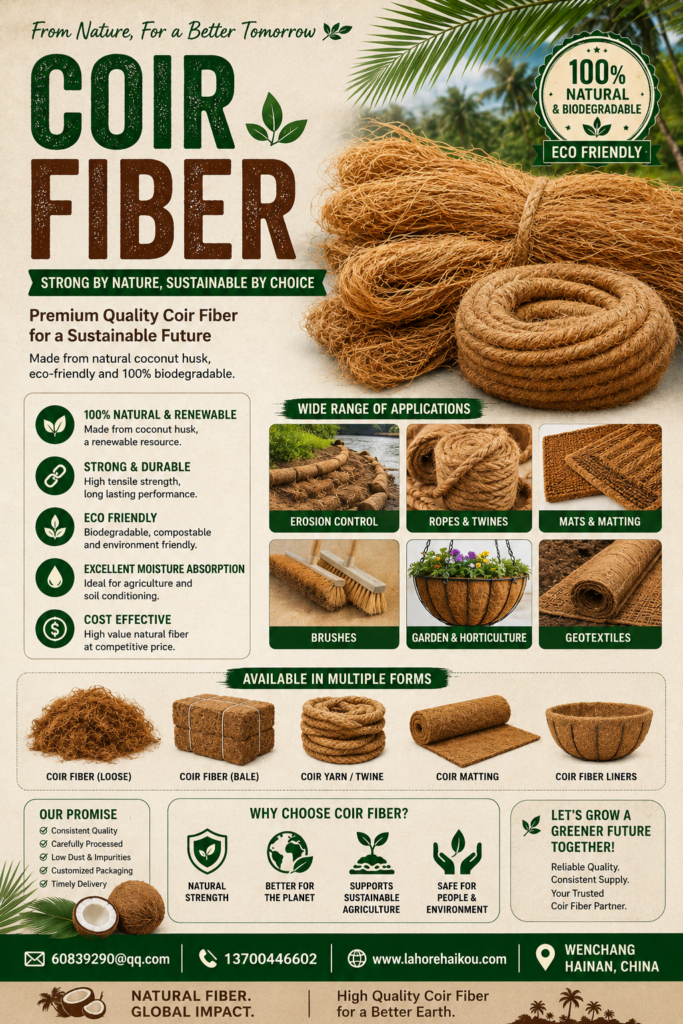
Coir fiber is a natural fiber obtained from coconut husks and is widely used in agriculture, horticulture, erosion control, landscaping, manufacturing, packaging, and other industries. For businesses purchasing large quantities, sourcing bulk coir fiber from Wenchang, Hainan, China can provide access to a coconut-producing region with local processing and export opportunities.
This buyer’s guide explains what bulk coir fiber is, the different types available, important quality specifications, packaging, shipping, and the key questions buyers should ask before placing an order.
What Is Coir Fiber?
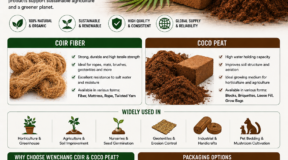
Coir fiber is extracted from the outer husk of coconuts. The husk contains strong natural fibers that can be separated, cleaned, dried, graded, and processed according to their intended application.
Depending on the processing method and coconut variety, coir fiber can have different lengths, thicknesses, colors, strength, and moisture levels.
Common coir fiber products include:
- Long coir fiber
- Short coir fiber
- Brown coir fiber
- White coir fiber
- Curled coir fiber
- Mattress-grade coir fiber
- Bristle fiber
- Coir fiber for agricultural applications
The right type depends on what the buyer intends to manufacture or produce.
Why Source Bulk Coir Fiber from Wenchang, Hainan?
Wenchang is located in Hainan Province, a major coconut-growing region in China. The local availability of coconut raw materials creates opportunities for businesses interested in sourcing coconut-derived products.
Buying from a supplier located close to the raw-material source can potentially offer advantages such as:
- Easier access to coconut husks
- Local processing
- Bulk-order capabilities
- Reduced inland transportation of raw materials
- Customized product specifications
- Export packaging options
However, buyers should evaluate each supplier individually. Production capacity, processing quality, product consistency, export experience, and documentation can vary between suppliers.
Main Uses of Coir Fiber
Bulk coir fiber is used in a wide range of industries.
1. Agriculture and Horticulture
Coir fiber can be used in horticultural products and growing-media applications. It can also be processed into various products used by nurseries and agricultural businesses.
2. Erosion Control
Coir fiber is used to manufacture erosion-control products such as:
- Coir erosion-control blankets
- Coir logs
- Coir mats
- Coir geotextiles
These products can be used for landscaping, slope stabilization, and erosion-management projects.
3. Ropes and Twine
Because coconut fiber is naturally strong and durable, it has traditionally been used to produce ropes, twine, and related products.
4. Mats and Carpets
Coir fiber can be processed into floor mats, entrance mats, carpets, and decorative products.
5. Brush Manufacturing
Certain grades of coir fiber are suitable for brushes and other cleaning products.
6. Mattress and Upholstery Products
Selected grades of coir fiber can be used in mattress and upholstery manufacturing.
7. Handicrafts and Sustainable Products
Coir fiber is also used in baskets, decorations, handicrafts, packaging products, and other environmentally oriented products.
Types of Coir Fiber Buyers Can Purchase
Before requesting a quotation, buyers should identify the specific fiber type they need.
Long Fiber
Long fibers are generally selected for applications where fiber length and strength are important.
Short Fiber
Shorter fibers may be suitable for products where exact fiber length is less important or where the fiber will be blended with other materials.
Brown Coir Fiber
Brown coir fiber comes from mature coconut husks and is generally thicker and more robust.
White Coir Fiber
White coir fiber is obtained from younger coconut husks and can have different characteristics from mature brown fiber.
Bristle Fiber
Bristle fiber consists of longer, relatively stiff fibers and may be used for specialized manufacturing applications.
The supplier should provide a clear specification sheet so buyers can determine whether the material is suitable for their intended use.
Important Coir Fiber Specifications
When purchasing bulk coir fiber, price should not be the only consideration.
Buyers should request detailed specifications such as:
Fiber length:
Specify the required minimum, maximum, or average fiber length.
Moisture content:
Moisture affects both product quality and shipping weight.
Color:
Specify whether you require natural brown, light-colored, or another grade.
Foreign matter:
Ask about the level of dust, soil, shell pieces, and other unwanted materials.
Fiber strength:
For manufacturing applications, strength may be an important purchasing criterion.
Fiber thickness:
Different applications may require different fiber diameters.
Cleaning level:
Confirm whether the fiber is washed, mechanically cleaned, or supplied in a more natural state.
Packaging:
Specify bale size, weight, wrapping, and labeling requirements.
What Is the Difference Between Long and Short Coir Fiber?
One of the most important questions for bulk buyers is whether they need long or short fiber.
Long coir fiber is generally more suitable for products such as ropes, mats, brushes, and certain geotextiles where fiber length is important.
Short coir fiber can be used for different composite, horticultural, filling, and manufacturing applications.
The correct choice depends on the final product.
Instead of simply asking for “coir fiber,” provide the supplier with information about your manufacturing process and final application.
How Is Coir Fiber Produced?
The general production process involves several stages.
Step 1: Coconut Husk Collection
Coconut husks are collected from coconut processing operations.
Step 2: Husk Processing
The husks are processed to separate useful fibers from the pith and other materials.
Step 3: Fiber Extraction
Mechanical or other processing methods are used to extract the coir fibers.
Step 4: Cleaning
The fibers are cleaned to remove unwanted material.
Step 5: Drying
The fiber is dried to achieve the required moisture level.
Step 6: Grading
The fiber is separated according to length, quality, color, and intended application.
Step 7: Baling
For bulk export, the fiber is normally compressed and packed into manageable bales.
Step 8: Quality Inspection
The finished product can be inspected according to the buyer’s agreed specifications before shipment.
Bulk Coir Fiber Packaging
Packaging becomes particularly important when ordering large quantities.
Depending on the buyer’s requirements, coir fiber may be supplied in compressed bales.
A buyer should confirm:
- Net weight per bale
- Bale dimensions
- Number of bales per container
- Packaging material
- Compression level
- Product labeling
- Pallet requirements, if applicable
Compressed packaging can help optimize container space and reduce unnecessary transportation volume.
Shipping Bulk Coir Fiber from Hainan, China
For international shipments, freight costs can have a significant impact on the final landed price.
Buyers should compare quotations based on the complete commercial arrangement rather than only the factory price.
Important factors include:
- Quantity
- Container size
- Port of loading
- Destination port
- Freight cost
- Insurance
- Customs requirements
- Export documentation
- Incoterms
Depending on the transaction, buyers may discuss FOB, CIF, or other suitable trade terms with the supplier and freight forwarder.
How to Calculate the Real Cost
When comparing suppliers, look beyond the quoted price per kilogram.
A useful comparison should consider:
Product price + packaging + inland transportation + export charges + freight + insurance + import costs = estimated landed cost
For example, Supplier A may offer a lower factory price but use less compressed packaging or have higher transportation costs. Supplier B may have a slightly higher product price but offer better loading efficiency.
Therefore, comparing the cost per usable kilogram after delivery can provide a more meaningful evaluation.
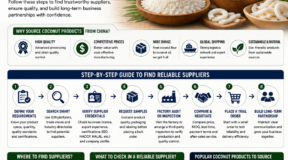
How to Buy Bulk Coir Fiber from China
A professional sourcing process can reduce misunderstandings and quality problems.
Step 1: Define Your Product Requirements
Prepare a specification sheet covering:
- Fiber type
- Fiber length
- Color
- Moisture
- Cleaning level
- Foreign matter tolerance
- Quantity
- Packaging
- Destination
Step 2: Contact Suppliers
Send the same requirements to several suppliers so you can compare quotations on an equivalent basis.
Step 3: Request Samples
Always consider requesting samples before placing a large order, particularly if the fiber will be used in manufacturing.
Step 4: Test the Sample
Check the sample against your production requirements.
Depending on the application, testing may include:
- Moisture
- Fiber length
- Strength
- Purity
- Foreign matter
- Color
- Density
Step 5: Confirm the Commercial Terms
Discuss:
- Product price
- Minimum order quantity
- Production time
- Payment terms
- Packaging
- Shipping terms
Step 6: Arrange Quality Inspection
For larger orders, buyers may consider pre-shipment inspection to verify that the goods match the agreed specifications.
Step 7: Ship the Goods
After production and inspection, the shipment can be arranged through the appropriate freight forwarder and export process.
Questions to Ask a Coir Fiber Supplier
Before ordering, ask the supplier:
- What type of coir fiber do you produce?
- What is the average fiber length?
- What is the moisture content?
- How is the fiber cleaned?
- What is the percentage of foreign matter?
- What is the weight of each bale?
- How many bales can fit in a container?
- Can you provide samples?
- What is your monthly production capacity?
- What export packaging is available?
- What is the minimum order quantity?
- Which shipping terms do you offer?
- Can you provide product specifications or test reports?
Clear answers to these questions can help buyers compare suppliers more effectively.
Who Buys Bulk Coir Fiber?
Bulk coir fiber can be suitable for businesses such as:
- Coir product manufacturers
- Rope manufacturers
- Mat manufacturers
- Brush manufacturers
- Mattress manufacturers
- Horticultural suppliers
- Landscaping companies
- Geotextile manufacturers
- Agricultural wholesalers
- Importers and distributors
- Sustainable-product manufacturers
How to Choose a Reliable Coir Fiber Supplier
A reliable supplier should be able to provide consistent product specifications and communicate clearly about production and export requirements.
Look for suppliers that can demonstrate:
Consistent quality – Product characteristics should remain reasonably consistent between shipments.
Production capability – The supplier should have sufficient capacity for your required volume.
Clear specifications – Measurements and quality parameters should be documented.
Sample availability – Samples allow you to evaluate the material before a large purchase.
Export experience – International shipments require appropriate documentation and logistics coordination.
Professional packaging – Bulk fiber should be protected during transportation and storage.
Sustainability of Coir Fiber
Coir fiber is derived from coconut husks, a natural agricultural material.
Using coconut husks to create useful products can provide an additional application for a material generated by the coconut industry.
Coir-based products are therefore increasingly considered in applications where businesses are looking for alternatives to certain synthetic or less renewable materials.
The environmental benefits of any specific coir product still depend on factors such as processing, transportation, product lifespan, and end-of-life management.
Final Checklist for Bulk Buyers
Before confirming your order, check the following:
☑ Fiber type confirmed
☑ Fiber length confirmed
☑ Moisture specification confirmed
☑ Color specification confirmed
☑ Cleaning requirements confirmed
☑ Foreign-matter limits confirmed
☑ Sample approved
☑ Bale weight confirmed
☑ Packaging confirmed
☑ Container loading plan confirmed
☑ Price and payment terms confirmed
☑ Incoterms confirmed
☑ Shipping arrangements confirmed
☑ Required import documentation confirmed
Conclusion
Bulk coir fiber from Wenchang, Hainan, China can be a practical sourcing option for manufacturers, wholesalers, agricultural businesses, and international importers.
The key to successful sourcing is to define your requirements clearly and evaluate suppliers based on quality, consistency, specifications, packaging, production capacity, logistics, and total landed cost rather than simply choosing the lowest quotation.
If you are planning to import coir fiber from China, start with a sample, confirm the technical specifications, calculate the complete landed cost, and establish clear quality requirements before moving to a large-volume order.
Start Your Coir Fiber Sourcing
Looking for bulk coir fiber from Wenchang, Hainan, China? Buyers can discuss their required fiber type, quantity, packaging, specifications, and destination before requesting a quotation.
Product: Bulk Coir Fiber
Origin: Wenchang, Hainan, China
Suitable for: Agriculture, horticulture, ropes, mats, brushes, geotextiles, manufacturing and other applications