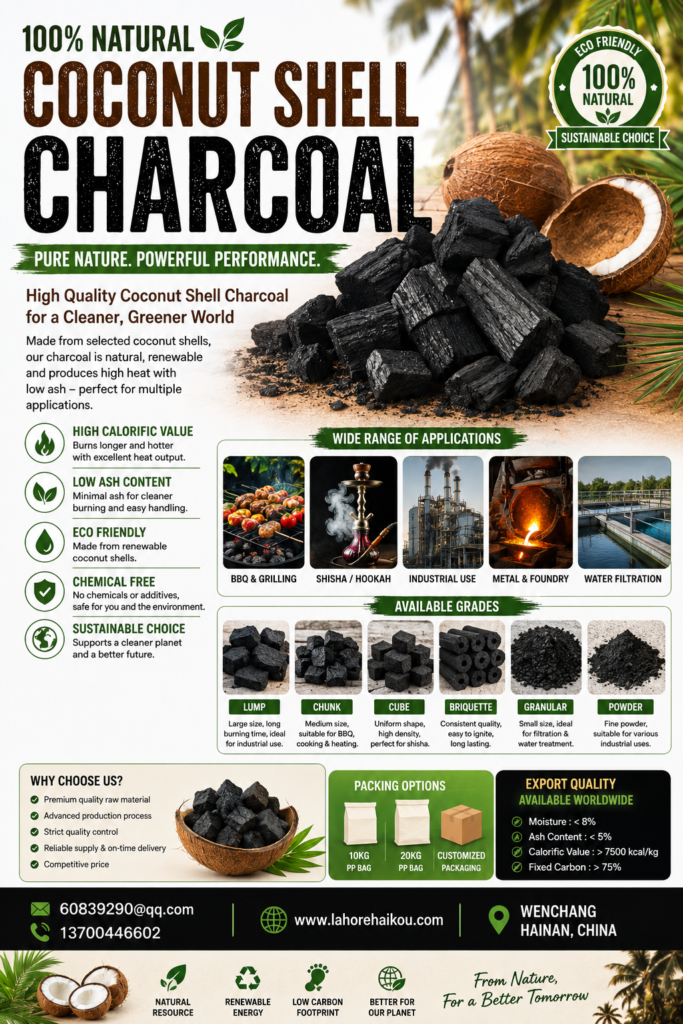
Coconut shell charcoal is a carbon-rich material produced by heating coconut shells under controlled conditions with limited oxygen. It is widely used in applications such as activated carbon production, industrial processes, and certain consumer charcoal products.
For international buyers, China offers a large manufacturing and trading market for charcoal and carbon-based products. However, choosing the right supplier requires more than comparing prices. Product specifications, raw material quality, ash content, moisture, fixed carbon, packaging, production capacity, and export requirements should all be considered.
This complete buyer’s guide explains the key factors to consider when sourcing coconut shell charcoal in China.
What Is Coconut Shell Charcoal?
Coconut shell charcoal is made from coconut shells, which are carbonized at high temperatures in a controlled environment.
The general process involves:
- Collecting coconut shells
- Cleaning and preparing the shells
- Drying the raw material
- Carbonizing the shells
- Cooling the charcoal
- Crushing or grading the material
- Testing the finished product
- Packing it for storage or export
Because coconut shells are a relatively dense biomass material, the resulting charcoal can have characteristics that make it useful for several industrial applications.
Why Buy Coconut Shell Charcoal from China?
China has an extensive manufacturing sector and established international logistics infrastructure. Buyers can find suppliers offering different grades, particle sizes, packaging formats, and customized specifications.
Potential advantages of sourcing from China include:
- Large manufacturing capacity
- Wide range of product specifications
- Customized packaging
- Private-label opportunities
- Competitive manufacturing costs
- Established export logistics
- Container-scale bulk supply
- Access to testing and processing facilities
However, not every supplier offers the same product quality. Buyers should carefully verify the actual manufacturing source and specifications before placing a large order.
Main Applications of Coconut Shell Charcoal
Coconut shell charcoal can be used for different purposes depending on its grade and processing method.
1. Activated Carbon Production
One of the major industrial applications of coconut shell charcoal is as a raw material for activated carbon.
Activated carbon is widely used in:
- Water treatment
- Air purification
- Industrial filtration
- Gas purification
- Wastewater treatment
- Certain chemical processing applications
The charcoal’s physical and chemical characteristics can influence its suitability for activated-carbon production.
2. Charcoal Briquettes
Coconut shell charcoal can be processed into briquettes by grinding, mixing, forming, and drying the material.
The specifications of briquettes can vary according to their intended application.
3. Industrial Carbon Applications
Certain grades of coconut shell charcoal are used as carbonaceous raw materials in industrial processes.
The appropriate grade depends on the buyer’s technical requirements and manufacturing process.
4. Consumer Charcoal Products
Processed coconut charcoal may also be used in certain consumer charcoal products. Buyers should ensure that products intended for consumer use meet the applicable safety, labeling, and regulatory requirements of their destination market.
Coconut Shell Charcoal vs. Wood Charcoal
Buyers often compare coconut shell charcoal with traditional wood charcoal.
| Feature | Coconut Shell Charcoal | Wood Charcoal |
|---|---|---|
| Raw material | Coconut shells | Wood |
| Source material | Agricultural by-product | Timber/wood |
| Density | Generally high | Varies |
| Ash | Depends on processing | Depends on wood and processing |
| Burning characteristics | Depends on grade | Depends on grade |
| Typical applications | Activated carbon, charcoal products, industrial uses | Cooking, heating, industrial and other uses |
| Sustainability considerations | Uses coconut-shell residues | Depends on wood source and forestry practices |
There is no universally superior charcoal. The best product depends on the application and required specifications.
Important Coconut Shell Charcoal Specifications
When purchasing in bulk, buyers should request a detailed specification sheet.
Fixed Carbon
Fixed carbon indicates the proportion of carbon remaining after volatile materials are removed under specified testing conditions.
For many industrial applications, fixed-carbon content is an important quality parameter.
Ash Content
Ash is the inorganic residue remaining after combustion.
Lower ash may be desirable for certain applications, but the appropriate specification depends on the intended use.
Moisture
Moisture affects the effective weight and handling characteristics of the product.
Buyers should establish a maximum moisture specification before purchasing.
Volatile Matter
Volatile matter represents combustible components released when the material is heated under specified testing conditions.
It can influence combustion characteristics and product performance.
Particle Size
Coconut shell charcoal can be supplied in different particle sizes, depending on its intended application.
Possible formats include:
- Powder
- Small granules
- Larger pieces
- Specified mesh sizes
- Crushed charcoal
The buyer should clearly state the required particle-size range.
Bulk Density
Bulk density is particularly important when planning container loading and transportation.
Two products with the same weight can occupy different volumes depending on their density and particle structure.
What Makes High-Quality Coconut Shell Charcoal?
There is no single specification that defines the best coconut shell charcoal for every application.
Instead, quality should be evaluated according to the intended use.
Important factors can include:
- Consistent raw materials
- Appropriate carbonization
- Low unwanted impurities
- Controlled moisture
- Suitable ash content
- Required fixed-carbon level
- Consistent particle size
- Proper storage
- Professional packaging
- Batch-to-batch consistency
For industrial applications, buyers should provide the supplier with a written specification rather than relying only on general terms such as “high quality.”
How Coconut Shell Charcoal Is Manufactured
Step 1: Raw Material Collection
Coconut shells are collected from coconut-processing operations.
Step 2: Cleaning
Foreign materials are removed from the shells.
Step 3: Drying
The shells are dried to reduce excessive moisture before carbonization.
Step 4: Carbonization
The shells are heated in a controlled environment with limited oxygen.
This converts the biomass into charcoal.
Step 5: Cooling
The charcoal is carefully cooled before further processing.
Step 6: Crushing and Screening
Depending on the product specification, charcoal can be crushed and screened into specific particle sizes.
Step 7: Quality Testing
Samples may be tested for parameters such as:
- Moisture
- Ash
- Fixed carbon
- Volatile matter
- Particle size
- Bulk density
Step 8: Packaging
The finished charcoal is packed according to the buyer’s requirements.
Bulk Packaging for Export
Packaging should be discussed before production starts.
Common bulk packaging options can include:
- Woven polypropylene bags
- Paper bags
- Inner plastic bags
- Cartons
- Compressed bags
- Palletized shipments
The appropriate packaging depends on the product, destination, handling requirements, and buyer’s preferences.
For container shipments, buyers should also confirm the expected net weight per bag, number of bags per container, and total container weight.
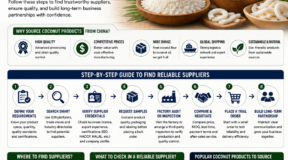
How to Import Coconut Shell Charcoal from China
International buyers can follow a structured sourcing process.
Step 1: Define Your Requirements
Prepare a specification sheet covering:
- Product type
- Application
- Fixed carbon
- Ash
- Moisture
- Volatile matter
- Particle size
- Packaging
- Required quantity
- Destination country
Step 2: Find Potential Suppliers
Compare several manufacturers or trading companies rather than selecting a supplier solely based on the lowest quotation.
Step 3: Request Samples
Ask for representative samples from the production batch whenever possible.
Step 4: Test the Samples
Testing should be based on your intended application.
For industrial purchases, laboratory testing can help verify the supplier’s specifications.
Step 5: Compare Quotations
Compare suppliers using the same product specifications and trade terms.
Step 6: Confirm the Order
Agree on:
- Product specifications
- Quantity
- Packaging
- Price
- Payment terms
- Production schedule
- Inspection requirements
- Shipping terms
Step 7: Arrange Inspection
For larger shipments, buyers may consider pre-shipment inspection or third-party testing.
Step 8: Ship the Order
The supplier and freight forwarder can coordinate export documentation and transportation to the destination port.
Questions to Ask a Chinese Charcoal Supplier
Before placing an order, ask:
- Are you a manufacturer or trading company?
- What is the source of your coconut shells?
- What is the fixed-carbon specification?
- What is the ash content?
- What is the moisture content?
- What is the volatile-matter specification?
- What particle sizes are available?
- Can you provide a recent laboratory test report?
- Can you provide a product sample?
- What is your monthly production capacity?
- What is the minimum order quantity?
- How is the product packaged?
- How much can be loaded into a container?
- What is the production lead time?
- What export terms are available?
Clear answers can help you distinguish between suppliers and reduce the risk of receiving a product that does not meet your requirements.
How to Compare Coconut Shell Charcoal Prices
The lowest price is not always the lowest total cost.
When comparing quotations, consider:
Product price + packaging + inland transportation + export charges + freight + insurance + import costs = estimated landed cost
Also compare the price on an equivalent basis.
For example, if one supplier quotes a price for charcoal with 15% moisture and another quotes a price for charcoal with 5% moisture, the prices should not be compared directly without accounting for the difference in actual dry material.
For industrial buyers, the cost per usable unit of material can be more meaningful than the simple price per kilogram.
Container Loading and Logistics
Coconut shell charcoal is a bulk product, so transportation efficiency can have a significant impact on overall cost.
Before ordering, ask the supplier for:
- Bag dimensions
- Net weight per bag
- Number of bags per container
- Estimated total net weight
- Estimated gross weight
- Container type
- Port of loading
Your freight forwarder can then help calculate the expected shipping cost to your destination.
Quality Control for Large Orders
Quality control becomes increasingly important as order volume increases.
For a large purchase, buyers may establish:
Pre-production confirmation
Confirm the exact product specifications before production.
Sample approval
Approve a reference sample.
Production monitoring
Confirm that production follows the agreed specifications.
Pre-shipment inspection
Inspect the finished goods before loading.
Laboratory testing
Test representative samples when technical specifications are critical.
A written quality agreement can help prevent disagreements between buyer and supplier.
Storage of Coconut Shell Charcoal
Charcoal should be stored in a suitable dry environment.
Important considerations include:
- Keep the product dry
- Protect it from rain and excessive humidity
- Avoid contamination
- Use appropriate packaging
- Keep away from ignition sources
- Follow applicable fire-safety requirements
Charcoal can present a fire hazard under certain conditions, so warehouses should follow local safety regulations and appropriate storage procedures.
Regulatory and Import Considerations
Import requirements differ between countries.
Before purchasing, buyers should check the regulations applicable to their destination market.
Depending on the product and intended use, requirements may involve:
- Customs documentation
- Product classification
- Packaging and labeling
- Safety requirements
- Environmental regulations
- Transportation requirements
- Agricultural or plant-material regulations
The importer should confirm the applicable requirements with local customs authorities and other relevant agencies before shipment.
How to Choose a Reliable Coconut Shell Charcoal Supplier in China
A reliable supplier should be able to provide clear information about its product and manufacturing process.
Consider the following factors:
Manufacturing capability
Check whether the supplier has sufficient production capacity for your required volume.
Product consistency
Ask about quality-control procedures and batch consistency.
Testing
Request recent test reports and compare them with your own requirements.
Sample quality
Do not place a large order without evaluating the product when the application is quality-sensitive.
Packaging
Make sure the packaging is suitable for long-distance transportation and storage.
Export experience
Suppliers with international experience may be more familiar with documentation and shipping procedures.
Communication
A professional supplier should provide clear and consistent answers to technical and commercial questions.
Common Mistakes Buyers Should Avoid
Choosing only by price
A very low quotation may reflect different specifications or quality.
Not requesting samples
A product description alone does not guarantee that the material will meet your requirements.
Ignoring moisture
Excess moisture increases shipping weight and can affect storage.
Not defining particle size
“Charcoal” can refer to products with very different particle sizes.
Failing to specify quality parameters
Always agree on measurable specifications.
Ordering too much too soon
A trial order can be useful before committing to a long-term supply contract.
Not checking import requirements
Always confirm destination-country regulations before shipment.
Bulk Coconut Shell Charcoal Buyer’s Checklist
Before confirming your order, check:
☑ Product type confirmed
☑ Intended application confirmed
☑ Fixed carbon specified
☑ Ash content specified
☑ Moisture specified
☑ Volatile matter specified
☑ Particle size specified
☑ Sample approved
☑ Test report reviewed
☑ Packaging confirmed
☑ Bale/bag weight confirmed
☑ Container loading confirmed
☑ Quantity confirmed
☑ Price confirmed
☑ Incoterms confirmed
☑ Production time confirmed
☑ Inspection requirements confirmed
☑ Import requirements checked
Conclusion
Coconut shell charcoal in China is available in a wide range of grades, particle sizes, packaging formats, and specifications. For international buyers, the key to successful sourcing is to focus on consistent quality, clear specifications, reliable production, professional packaging, and total landed cost rather than simply choosing the cheapest supplier.
Before placing a large order, define your requirements, request samples, verify technical specifications, and consider appropriate inspection and testing.
For businesses looking for bulk supply, a clear specification sheet and long-term communication with the supplier can help create a more reliable purchasing process.
Looking for Coconut Shell Charcoal from China?
If you are sourcing bulk coconut shell charcoal from China, provide your required quantity, application, specifications, packaging requirements, and destination. This allows suppliers to prepare a more accurate quotation and shipping plan.
Product: Coconut Shell Charcoal
Origin: China
Suitable for: Activated carbon production, industrial applications, charcoal products, and other suitable uses
Supply: Bulk / Wholesale / Export