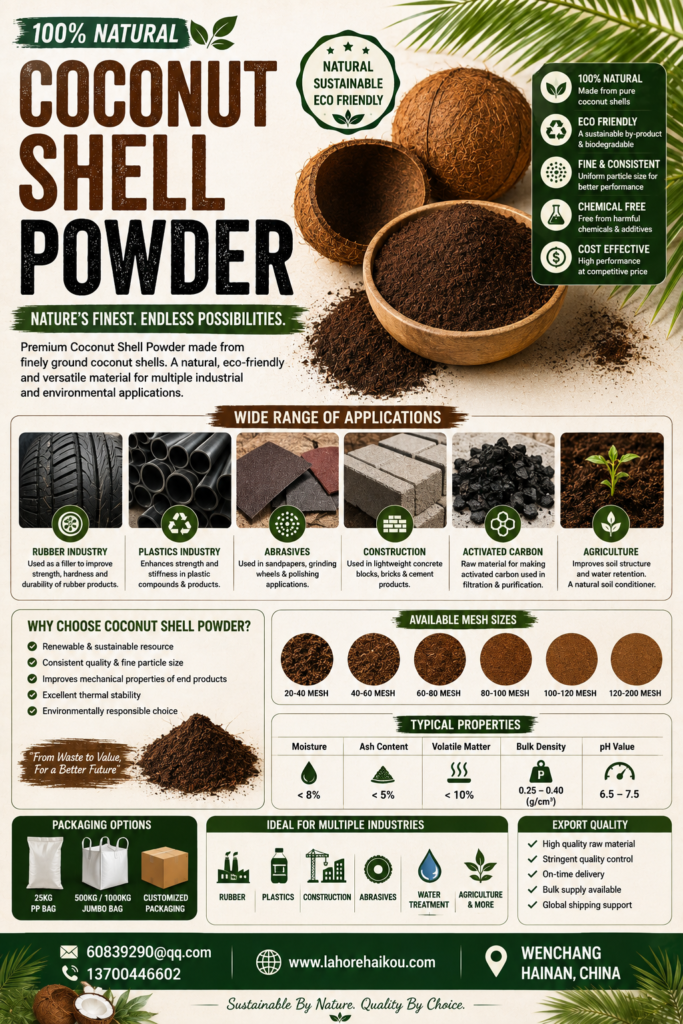
Coconut shell powder is a finely processed material made from coconut shells. Because coconut shells are hard, durable, and rich in carbon, the material can be processed into different particle sizes for use in industrial, agricultural, manufacturing, and other applications.
For businesses looking to source coconut shell powder from China, Wenchang in Hainan Province is an interesting sourcing location because of its connection to the coconut industry and availability of coconut-based raw materials.
This complete buyer’s guide explains what coconut shell powder is, how it is produced, its applications, important specifications, packaging, shipping, quality control, and the key questions buyers should ask suppliers before placing a bulk order.
What Is Coconut Shell Powder?
Coconut shell powder is produced by processing dried coconut shells into smaller particles and grinding them into a specified powder or granular size.
The general production process can include:
- Coconut shell collection
- Cleaning
- Drying
- Crushing
- Grinding
- Screening
- Particle-size classification
- Quality inspection
- Packaging
The final product can be supplied in different mesh sizes depending on the buyer’s intended application.
Why Source Coconut Shell Powder from Wenchang, Hainan?
Wenchang is a city in Hainan Province with a strong connection to coconut cultivation and processing.
For businesses sourcing coconut-based materials, the region can provide access to coconut shells and other coconut by-products.
Potential advantages of sourcing locally include:
- Access to coconut raw materials
- Local processing opportunities
- Bulk supply potential
- Customized particle sizes
- Export-oriented packaging
- Convenient access to Hainan logistics networks
However, buyers should evaluate suppliers individually. The quality and specifications of coconut shell powder can vary significantly depending on raw materials, processing equipment, grinding methods, and quality-control procedures.
Common Applications of Coconut Shell Powder
Coconut shell powder has a wide range of potential applications.
The appropriate grade depends heavily on the final product and required technical characteristics.
1. Activated Carbon Production
Coconut shells are widely used as a raw material for activated carbon production.
Depending on the manufacturing process, coconut shell-derived material can be converted into activated carbon used in filtration and purification applications.
For this application, buyers should not assume that every coconut shell powder grade is suitable for activated carbon production. The supplier should provide appropriate technical specifications and raw-material information.
2. Abrasive Products
Coconut shell particles can be processed into abrasive materials for selected applications.
The required particle size, hardness, cleanliness, and consistency depend on the intended manufacturing process.
3. Composite Materials
Coconut shell powder can be incorporated into certain composite materials and polymer-based products.
It may be used as a natural filler in applications where manufacturers want to incorporate agricultural-derived materials into their products.
4. Decorative and Craft Products
Fine coconut shell powder can be used in selected decorative, handicraft, and artistic applications.
Its natural appearance can be attractive for products emphasizing natural materials.
5. Agriculture and Soil-Related Applications
Certain coconut shell-derived materials may be used in agricultural products and soil-related applications.
However, the suitability of coconut shell powder for a particular agricultural application should be confirmed through product testing and agronomic evaluation.
6. Industrial Filler Applications
Depending on particle size and processing characteristics, coconut shell powder can be considered for selected filler applications.
The exact requirements should be specified by the manufacturer purchasing the material.
Understanding Coconut Shell Powder Mesh Sizes
One of the most important specifications for buyers is particle size.
Coconut shell powder can be processed into different mesh grades.
For example, a supplier may offer specifications such as:
- Coarse particles
- Medium particles
- Fine powder
- Extra-fine powder
- Customized mesh sizes
The exact meaning of a mesh specification should be confirmed with the supplier because particle-size distribution can vary even when products are described using the same nominal mesh number.
If particle size is critical to your production process, request a particle-size distribution report rather than relying only on a product name.
Important Coconut Shell Powder Specifications
Before ordering bulk quantities, buyers should request a technical specification sheet.
Particle Size
Specify the required mesh or particle-size distribution.
Moisture Content
Moisture affects product weight, storage, and processing.
A maximum moisture level should be agreed upon before production.
Ash Content
Ash represents inorganic residue remaining after combustion.
The acceptable ash level depends on the intended application.
Bulk Density
Bulk density affects packaging and container loading.
Purity
Ask about unwanted materials such as:
- Sand
- Soil
- Stones
- Metal
- Coconut fiber
- Other foreign matter
Color
Natural coconut shell powder may have variations in color depending on the raw material and processing method.
If color consistency is important, establish a clear specification.
Odor
The material should be properly dried and stored to minimize unwanted odors or contamination.
What Makes High-Quality Coconut Shell Powder?
The definition of “high quality” depends on the application.
For industrial buyers, important factors can include:
- Consistent particle size
- Controlled moisture
- Low foreign matter
- Appropriate ash content
- Clean raw materials
- Consistent color
- Proper grinding
- Reliable packaging
- Batch-to-batch consistency
The best way to establish quality is to create a written specification agreed upon by both buyer and supplier.
How Coconut Shell Powder Is Manufactured
Step 1: Collecting Coconut Shells
Coconut shells are collected from coconut-processing operations.
Step 2: Cleaning
The shells are cleaned to remove dirt and other unwanted materials.
Step 3: Drying
The shells are dried to reduce moisture before crushing and grinding.
Step 4: Crushing
Large coconut shells are broken into smaller pieces using crushing equipment.
Step 5: Grinding
The crushed shells are processed using grinding equipment to achieve the required particle size.
Step 6: Screening
The material is screened to separate different particle sizes.
Step 7: Quality Control
Samples may be tested for:
- Moisture
- Particle size
- Ash
- Bulk density
- Foreign matter
Step 8: Packaging
The finished coconut shell powder is packed according to customer requirements.
Bulk Packaging for Export
Packaging is an important consideration for international buyers.
Coconut shell powder can potentially be packed in:
- Woven polypropylene bags
- Kraft paper bags
- Plastic-lined bags
- Jumbo bags
- Palletized packages
- Customized export packaging
The ideal packaging depends on the particle size, quantity, transportation method, storage environment, and buyer requirements.
Before placing an order, confirm:
- Net weight per bag
- Gross weight
- Bag dimensions
- Number of bags per container
- Inner lining
- Labeling requirements
- Pallet requirements
How to Import Coconut Shell Powder from China
Importers can follow a structured sourcing process.
Step 1: Define Your Product Requirements
Prepare a specification sheet containing:
- Product type
- Application
- Particle size
- Moisture
- Ash
- Purity
- Color
- Packaging
- Quantity
- Destination
Step 2: Contact Suppliers
Send the same specifications to several potential suppliers.
This makes price and quality comparisons easier.
Step 3: Request Samples
Always consider requesting samples before placing a large commercial order.
Step 4: Test the Samples
If the material will be used in manufacturing, conduct appropriate laboratory or production testing.
Step 5: Compare Quotations
Compare suppliers based on equivalent specifications and commercial terms.
Step 6: Confirm the Order
Agree on:
- Product specifications
- Quantity
- Packaging
- Price
- Payment terms
- Production schedule
- Inspection requirements
- Shipping terms
Step 7: Conduct Inspection
For large orders, consider pre-shipment inspection or third-party laboratory testing.
Step 8: Arrange Shipping
The supplier and freight forwarder can coordinate the export process and transportation to your destination.
Questions to Ask a Coconut Shell Powder Supplier
Before placing a bulk order, ask:
- Are you a manufacturer or trading company?
- Where do you source your coconut shells?
- What particle sizes can you produce?
- Can you provide a particle-size distribution?
- What is the moisture content?
- What is the ash content?
- How much foreign matter is present?
- What is the bulk density?
- Can you provide a recent test report?
- Can you provide samples?
- What is your monthly production capacity?
- What is the minimum order quantity?
- How is the product packaged?
- How much can be loaded into a container?
- What are your production and shipping lead times?
Clear answers to these questions help buyers evaluate suppliers more effectively.
How to Compare Coconut Shell Powder Prices
The cheapest quotation is not necessarily the best deal.
When comparing suppliers, consider:
Product price + packaging + inland transportation + export charges + freight + insurance + import costs = estimated landed cost
Buyers should also compare products on an equivalent specification basis.
For example, a supplier offering a lower price may be providing a product with:
- Higher moisture
- Different particle size
- Higher ash
- More foreign material
- Different packaging
A fair comparison requires equivalent specifications.
Container Loading and Logistics
Coconut shell powder is a bulk material, so packaging efficiency can influence transportation costs.
Ask suppliers to provide:
- Bag size
- Net weight per bag
- Number of bags per container
- Estimated total net weight
- Gross weight
- Container type
- Port of loading
Your freight forwarder can then calculate the expected shipping cost to your destination.
Quality Control for Bulk Orders
Quality control is particularly important for large-volume purchases.
A practical process can include:
Sample approval
Approve a representative sample before production.
Written specification
Record all important technical parameters in the purchase agreement.
Production monitoring
Ensure the supplier follows the agreed manufacturing process.
Pre-shipment inspection
Inspect the finished material before loading when appropriate.
Laboratory testing
For technical applications, test representative samples against agreed specifications.
This process can reduce the risk of receiving material that does not match your production requirements.
Storage of Coconut Shell Powder
Coconut shell powder should be stored in a clean and dry environment.
Recommended considerations include:
- Protect from rain and moisture
- Keep packaging sealed
- Avoid contamination
- Store on suitable pallets where appropriate
- Maintain good warehouse ventilation
- Follow applicable workplace safety requirements
Fine organic powders can create dust during handling, so buyers should follow appropriate industrial dust-control and occupational-safety procedures.
Regulatory and Import Requirements
Import requirements vary by destination country.
Before purchasing coconut shell powder, buyers should verify applicable:
- Customs requirements
- Product classification
- Documentation
- Packaging regulations
- Environmental requirements
- Agricultural requirements, if applicable
- Transportation requirements
Importers should confirm the current rules with their local customs authority and other relevant government agencies.
How to Choose a Reliable Supplier in Wenchang
When sourcing from Wenchang, buyers should evaluate suppliers based on several factors.
Raw-material availability
Ask where the coconut shells come from and whether the supplier has reliable access to raw materials.
Processing capability
Confirm that the supplier has suitable crushing, grinding, and screening equipment.
Production capacity
Make sure the supplier can consistently supply your required volume.
Quality control
Ask how the company tests particle size, moisture, ash, and foreign matter.
Sample availability
Request a sample before committing to a large order.
Export experience
International buyers should check whether the supplier has experience with export packaging and documentation.
Communication
Clear communication is essential when discussing technical specifications and quality requirements.
Common Mistakes Buyers Should Avoid
1. Buying only based on price
A lower price may indicate different specifications.
2. Not checking particle size
Different applications require different particle sizes.
3. Not requesting a sample
A sample allows you to evaluate the actual material.
4. Ignoring moisture
High moisture can increase transportation costs.
5. Not defining foreign-matter limits
Make your purity requirements clear before production.
6. Comparing different specifications
Always compare equivalent products.
7. Ordering a large quantity without testing
A trial order can be useful before establishing a long-term supply relationship.
Bulk Coconut Shell Powder Buyer’s Checklist
Before confirming your purchase:
☑ Application confirmed
☑ Particle size confirmed
☑ Particle-size distribution checked
☑ Moisture specification confirmed
☑ Ash specification confirmed
☑ Purity requirements confirmed
☑ Foreign matter specification confirmed
☑ Sample approved
☑ Test report reviewed
☑ Packaging confirmed
☑ Net weight confirmed
☑ Container loading confirmed
☑ Quantity confirmed
☑ Price confirmed
☑ Payment terms confirmed
☑ Incoterms confirmed
☑ Production schedule confirmed
☑ Inspection requirements confirmed
☑ Import regulations checked
Conclusion
Coconut shell powder from Wenchang, Hainan, China can be a useful raw material for manufacturers and businesses seeking coconut-derived materials for industrial and commercial applications.
Successful bulk sourcing depends on clearly defining the required particle size, moisture, ash, purity, packaging, quantity, and application.
Rather than selecting a supplier solely based on price, international buyers should request samples, verify specifications, compare landed costs, and establish clear quality requirements before placing large orders.
With proper product specifications and quality control, buyers can build a more reliable supply chain for coconut shell powder from China.
Looking for Bulk Coconut Shell Powder from China?
If you are looking for coconut shell powder from Wenchang, Hainan, China, provide your required particle size, quantity, application, packaging requirements, and destination.
A clear specification allows suppliers to prepare a more accurate quotation and recommend the appropriate product grade.
Product: Coconut Shell Powder
Origin: Wenchang, Hainan, China
Supply: Bulk / Wholesale / Export
Applications: Industrial, manufacturing, composite, abrasive, activated-carbon-related and other suitable applications