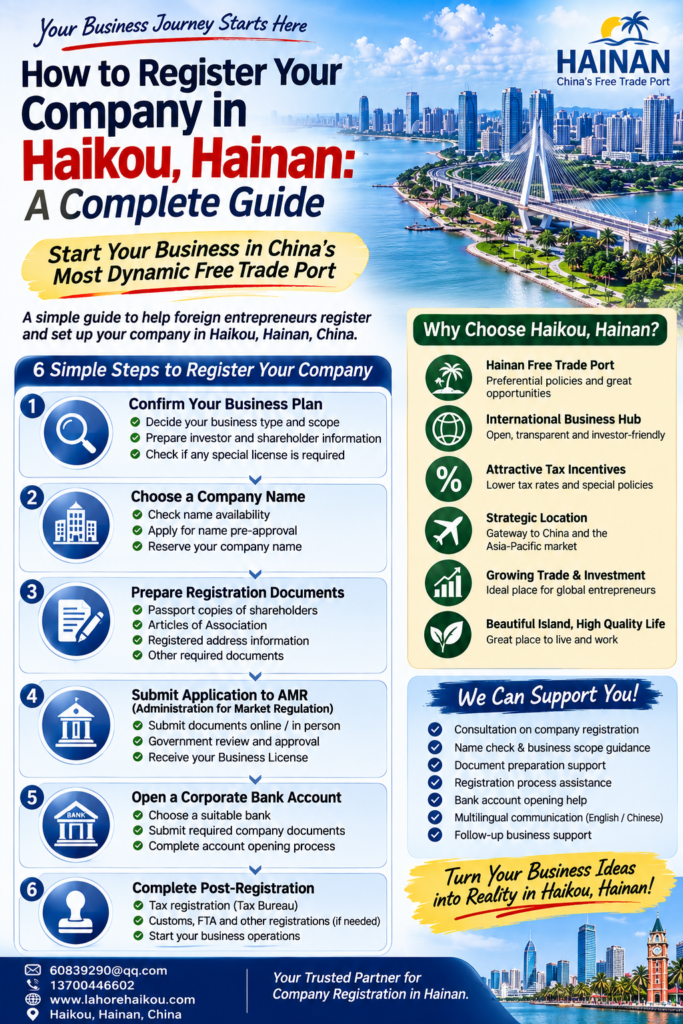
Starting a company in China can be an exciting opportunity for international entrepreneurs, trading businesses, sourcing companies, service providers, and investors.
Haikou, Hainan is an increasingly attractive location for businesses because it is the capital of Hainan Province and part of the Hainan Free Trade Port.
For foreign entrepreneurs, however, registering a company involves more than simply obtaining a business license. You need to consider the proposed business scope, ownership structure, registered address, documentation, tax and accounting obligations, banking, company seals, and any industry-specific licenses.
This guide explains the general process of registering a company in Haikou, Hainan, China, and highlights important considerations for foreign investors.
Why Start a Company in Haikou, Hainan?
Hainan is China’s Free Trade Port and has introduced policies designed to promote investment liberalization and facilitation.
The Hainan Free Trade Port operates under a pre-establishment national treatment plus negative-list system for foreign investment. In general, sectors outside the applicable negative list are treated according to the same principles as domestic investment, while restricted or prohibited sectors may have additional requirements.
Hainan’s official investment website highlights industries including:
- Tourism
- Modern services
- High-tech industries
- Tropical agriculture
- Healthcare
- Consumer industries
- Aerospace
- Deep-sea industries
- Seed industries
The province reported 9,979 foreign-invested enterprises at the end of 2024, demonstrating the significant presence of foreign businesses in Hainan.
For entrepreneurs considering China sourcing, international trade, professional services, technology, tourism-related activities, or other permitted businesses, Haikou can therefore be worth considering.
Who Can Register a Company in Haikou?
Hainan’s official guidance states that qualified applicants for foreign-invested enterprises can include foreign natural persons, foreign enterprise legal persons, public institution legal persons, social organization legal persons, unincorporated organizations, administrative organs, and other organizations.
The appropriate structure depends on your circumstances and business activities.
A foreign entrepreneur may establish a company subject to the applicable Chinese laws and registration requirements.
Common considerations include:
- Number of shareholders
- Ownership structure
- Proposed business activities
- Registered address
- Company name
- Legal representative
- Directors and other management personnel
- Capital contribution arrangements
- Industry-specific requirements
For many small and medium-sized businesses, a limited liability company may be the structure considered, but the appropriate structure should be confirmed according to the specific business plan.
Step 1: Decide Your Business Activities
Before registering your company, clearly define what the company will actually do.
For example, your business may focus on:
- International trading
- Product sourcing
- Import and export
- E-commerce
- Consulting
- Marketing services
- Technology services
- Manufacturing
- Tourism-related services
- Professional services
Your proposed activities are important because they can affect the registration process and whether additional licenses or approvals are required.
For foreign investment, the first important question is whether your proposed activity falls within the applicable Foreign Investment Negative List or another restricted regulatory regime.
Hainan’s official guidance states that fields outside the applicable negative list are generally administered under the principle of equal treatment for domestic and foreign capital.
Step 2: Choose Your Company Structure
Once you know your business activities, determine the appropriate company structure.
Hainan’s official company-establishment guide confirms that both limited liability companies and joint-stock limited companies can apply for establishment registration.
For a typical small or medium-sized commercial business, a limited liability company may be a practical structure, but this depends on your circumstances.
Your company will generally need information such as:
- Company name
- Shareholders
- Legal representative
- Directors and management
- Articles of association
- Registered address
- Business scope
- Capital contribution arrangements
Step 3: Choose a Company Name
Your proposed Chinese company name needs to meet China’s company-name requirements.
It is advisable to prepare several potential names because your first choice may not be available.
When preparing a company name, consider:
- Chinese-language requirements
- Company-name structure
- Industry description
- Availability
- Registration requirements
- Trademark considerations
A company name and a trademark are not the same thing. If your brand is important, consider checking trademark availability separately.
Step 4: Prepare a Registered Address
A registered company needs an appropriate registered address.
The address is an important part of the company registration application.
Depending on the company and local requirements, possible arrangements may include an appropriate commercial office or another legally acceptable registered address.
Before signing an office agreement, verify that the premises can legally be used for the proposed company and business activities.
Hainan’s official guidance lists having a registered address among the basic requirements for establishing a limited liability company.
Step 5: Prepare the Required Documents
Documentation requirements vary depending on the company structure and shareholders.
Documents and information may include:
- Passport or identification documents
- Shareholder information
- Company name
- Articles of association
- Registered-address information
- Business scope
- Legal representative information
- Director and management information
- Foreign investor qualification or identification documents
- Other documents required by the registration authority
Foreign documents may require additional procedures depending on their origin and the current rules.
Importantly, Hainan introduced additional registration facilitation measures in 2026. From June 30, 2026, eligible foreign investors can benefit from expanded document mutual-recognition arrangements and online identity verification options under the provincial market-regulation authority’s measures.
Because procedures can change, applicants should confirm the current document requirements before preparing or submitting an application.
Step 6: Submit the Company Registration Application
Hainan provides an online Hainan e-Registration system for business establishment.
The official business-startup process includes:
- Real-name registration
- Completing business-establishment information
- Providing required company information
- Real-name verification
- Electronic signatures
- Submission of the application
- Review by the relevant authorities
The system can also incorporate information relating to areas such as social insurance, tax invoices, company seals, and bank pre-account opening.
For foreign-invested companies, additional information may be required depending on the ownership structure and business activities.
Step 7: Complete Real-Name Verification and Electronic Signatures
Relevant company personnel may need to complete real-name verification and electronic signing.
Hainan’s official process identifies parties such as the:
- Legal representative
- Shareholders
- Directors
- Supervisors, where applicable
- Senior management
- Designated representative or entrusted agent
as potentially requiring verification or electronic signatures depending on the company structure.
This is one reason that professional local assistance can be useful for foreign entrepreneurs who are unfamiliar with China’s online registration systems.
Step 8: Obtain the Business License
After the registration application has been reviewed and approved, the company can obtain its business license and other applicable registration materials.
Hainan’s official business-startup guide states that, after processing through the relevant departments, applicants can collect the business license, company seal and invoices through the applicable process.
The business license is an important document confirming the company’s registered status.
Step 9: Company Seals
Company seals are an important part of doing business in China.
Depending on the company’s requirements, different seals may be involved, such as:
- Company official seal
- Financial seal
- Legal representative seal
- Contract seal
- Invoice seal
The exact seals required depend on the company’s activities and administrative arrangements.
Proper control and storage of company seals is extremely important.
Step 10: Open a Corporate Bank Account
After company establishment, you may need to open a corporate bank account.
The bank may conduct its own compliance and identity checks.
Depending on your business, you may also need to consider foreign-exchange registration and cross-border payment arrangements.
Hainan’s official guidance notes that, after establishment, a foreign-invested enterprise can proceed with foreign-exchange registration and bank-account opening as needed through a bank appointment process.
Bank requirements can differ, so confirm the latest requirements directly with the selected bank.
Step 11: Complete Tax and Accounting Setup
Registering the company is only the beginning.
Once your company starts operating, you need to manage its ongoing tax and accounting responsibilities.
These may include:
- Tax declarations
- Accounting records
- Invoicing
- Payroll
- Social insurance
- Corporate income-tax matters
- VAT-related matters
- Annual reporting
- Financial compliance
The actual obligations depend on your company’s activities and financial situation.
For this reason, many foreign-owned businesses choose to work with a qualified local accounting or tax service provider.
Step 12: Consider Import and Export Registration
If your Haikou company will conduct international trade, additional customs and import/export procedures may be relevant.
For example, a trading company importing or exporting products may need to consider:
- Customs registration
- Import/export procedures
- Foreign-exchange arrangements
- Product-specific requirements
- Customs declarations
- Shipping documentation
- Tax and accounting treatment
The exact requirements depend on your products and business model.
If your company will only provide domestic services, the requirements may be different.
Step 13: Check Whether Your Business Requires Special Licenses
Not every business can operate solely on the basis of a general business license.
Some industries are subject to additional licensing or approval requirements.
Examples can include certain activities involving:
- Food
- Healthcare
- Education
- Financial services
- Telecommunications
- Pharmaceuticals
- Transportation
- Certain professional services
- Other regulated industries
Before registering, determine whether your intended business activity requires additional authorization.
How Long Does Company Registration Take?
The actual timeline can vary depending on:
- Company structure
- Business activity
- Document completeness
- Foreign-investor documentation
- Name availability
- Registered address
- Industry approvals
- Government review
- Bank procedures
A straightforward registration may move faster than a business requiring additional approvals.
Therefore, it is better to prepare a realistic timeline after reviewing your specific business situation rather than relying on a single advertised number of days.
How Much Does It Cost to Register a Company in Haikou?
The total cost depends on your circumstances.
Potential expenses may include:
- Company registration-related services
- Registered address
- Translation
- Document certification
- Company seals
- Accounting services
- Tax services
- Bank-related costs
- Legal or professional consulting
- Industry-specific licenses
- Office rental
- Employee-related costs
There is no single fixed price that applies to every foreign company.
If you are comparing service providers, ask for a complete quotation showing what is included and what is charged separately.
Can a Foreigner Own a Company in Haikou?
Foreign investment is permitted in many areas, subject to China’s foreign-investment rules.
Hainan operates under a foreign-investment negative-list system, meaning that sectors outside the applicable list are generally subject to national-treatment principles, while restricted sectors have additional conditions and prohibited sectors cannot receive foreign investment.
Therefore, the answer depends on your proposed business activity.
Before investing, check the current negative list and any industry-specific rules applicable to your business.
Why Consider Haikou for an International Business?
Haikou can be particularly interesting for businesses connected with:
International Trade
Companies can use Hainan as a base for China-related sourcing and international trade activities.
China Sourcing
Businesses can establish a local presence while communicating with Chinese suppliers and manufacturers.
Professional Services
Consulting, marketing, technology, and other permitted service businesses may consider Haikou.
Tourism
Tourism is one of Hainan’s key industries.
Modern Services
Hainan identifies modern services as one of its pillar industries.
High-Tech Businesses
Technology and high-tech industries are among the areas promoted by Hainan’s investment-development strategy.
Important: Company Registration Is Not the Same as a Visa
One common misunderstanding is assuming that registering a Chinese company automatically gives a foreign entrepreneur the right to live and work in China.
These are separate matters.
A company registration establishes a business entity. Immigration status, residence permits, and work authorization are governed by separate rules and depend on the individual’s circumstances.
If you plan to personally work in China for your company, obtain appropriate professional immigration advice regarding your visa and work-permit options.
Common Mistakes Foreign Entrepreneurs Should Avoid
1. Choosing the Business Scope Too Quickly
Your business scope should reflect your actual planned activities and applicable regulations.
2. Renting an Address Before Checking Requirements
Make sure the proposed address is appropriate for your intended business.
3. Focusing Only on Registration Cost
A cheap registration package may exclude important services such as accounting, tax support, address services, or licensing.
4. Ignoring Tax Compliance
Obtaining a business license does not remove ongoing tax and accounting responsibilities.
5. Not Checking the Negative List
Foreign investors should determine whether their business falls within a restricted or prohibited sector.
6. Assuming Every Industry Has the Same Process
A trading company and a regulated healthcare or education business may have very different requirements.
7. Not Planning for Banking
Opening a corporate bank account can involve separate compliance checks and documentation.
Haikou Company Registration Checklist
Before starting the registration process, prepare:
☑ Business idea confirmed
☑ Business activities defined
☑ Foreign-investment access checked
☑ Company structure selected
☑ Company name prepared
☑ Shareholder information prepared
☑ Legal representative selected
☑ Registered address confirmed
☑ Business scope prepared
☑ Articles of association prepared
☑ Required identification documents prepared
☑ Foreign documents checked for required formalities
☑ Registration application prepared
☑ Electronic-signature requirements confirmed
☑ Business license obtained
☑ Company seals arranged
☑ Bank account arrangements planned
☑ Tax and accounting support arranged
☑ Import/export requirements checked, if applicable
☑ Special licenses checked, if applicable
Why Work with Local Business Registration Support?
For foreign entrepreneurs, the biggest challenge is often not the registration form itself but understanding the entire process.
Local support can help with:
- Business-structure discussions
- Document preparation
- Chinese-language communication
- Registration coordination
- Registered-address arrangements
- Company-seal procedures
- Accounting coordination
- Tax-service coordination
- Bank-account preparation
- Import/export setup guidance
Professional assistance can make the process easier to organize, particularly for entrepreneurs who are not familiar with Chinese administrative procedures.
Start Your China Business Journey Today
Registering a company in Haikou, Hainan can be an important first step for entrepreneurs who want to establish a business presence in China.
The process involves several stages, from selecting the right business structure and preparing documents to obtaining the business license, arranging banking, handling tax compliance, and meeting any industry-specific requirements.
The most important step is to understand your specific business activity before beginning the registration process.
If you are considering establishing a company in Haikou, prepare your business plan, ownership information, proposed business scope, and registered-address requirements first.
START YOUR CHINA BUSINESS JOURNEY TODAY
📱 13700446602
📍 Haikou, Hainan, China
Contact Us
Tell us about your proposed business, ownership structure, business activities, and requirements.
We can help you understand the general company-registration process in Haikou and coordinate the next steps with the relevant local service providers.
Start your China business journey from Haikou, Hainan.