Coconut oil is one of the world’s most widely traded coconut-derived products. It is used across the food, personal-care, cosmetics, soap, wellness, and manufacturing industries.
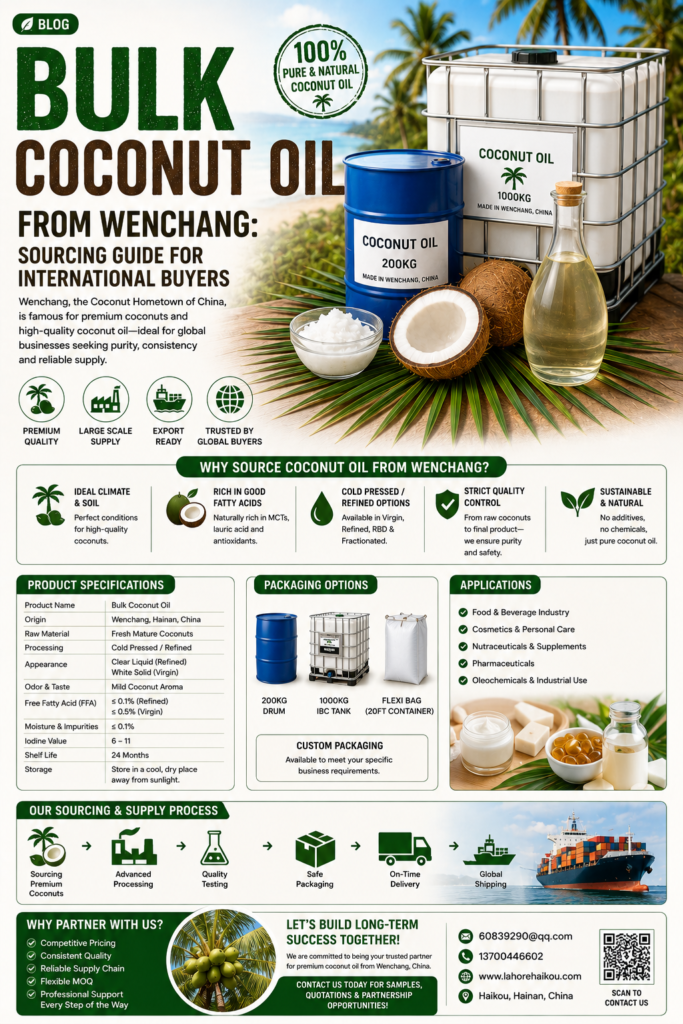
For international buyers looking to source coconut oil from China, Wenchang, Hainan is an important location to consider because of its long-standing connection with coconut cultivation and coconut processing.
Whether you are a food manufacturer, cosmetic company, wholesaler, distributor, private-label brand, or international trading company, purchasing coconut oil in bulk requires careful supplier selection and product evaluation.
This guide explains what international buyers should know when sourcing bulk coconut oil from Wenchang, Hainan, China.
Why Source Coconut Oil from Wenchang, Hainan?
Wenchang is located in northeastern Hainan and is widely associated with coconut cultivation in the province.
The local coconut industry supports a range of coconut-based products, including:
- Coconut oil
- Virgin coconut oil
- Coconut milk
- Coconut cream
- Coconut water
- Desiccated coconut
- Coconut powder
- Coconut candy
- Coconut shell charcoal
- Coconut shell powder
- Coir fiber
- Coco peat
For international buyers, this concentration of coconut-related businesses can make Wenchang an interesting starting point when researching suppliers.
However, buyers should evaluate each supplier individually rather than assuming that every local company offers the same quality, capacity, or export capability.
What Is Coconut Oil?
Coconut oil is extracted from coconut meat.
Depending on the production process, coconut oil can have different characteristics and may be marketed for different applications.
Common categories include:
- Virgin coconut oil
- Refined coconut oil
- Expeller-pressed coconut oil
- Cold-processed coconut oil
- Organic coconut oil, where properly certified
The appropriate type depends on how you intend to use the product.
A food manufacturer, cosmetics company, and soap manufacturer may have completely different requirements.
Virgin Coconut Oil vs. Refined Coconut Oil
One of the first questions an international buyer should answer is which type of coconut oil is required.
Virgin Coconut Oil
Virgin coconut oil is generally produced using processes designed to retain more of the coconut’s characteristic aroma and flavor.
It may be considered for:
- Food products
- Functional foods
- Cosmetics
- Personal-care products
- Premium consumer products
Buyers should ask suppliers exactly how their “virgin” product is produced and what specification applies.
Refined Coconut Oil
Refined coconut oil undergoes additional processing and generally has a more neutral flavor and odor.
It may be used in:
- Food manufacturing
- Cooking
- Cosmetics
- Soap production
- Industrial applications
The best option depends on your final product and technical requirements.
Important Coconut Oil Specifications
When requesting quotations, don’t simply ask:
“What is your coconut oil price?”
Instead, provide a detailed product specification.
Important parameters can include:
Appearance
Ask about the expected color and physical appearance of the oil.
Odor and Flavor
These characteristics can vary between virgin and refined products.
Free Fatty Acids
FFA is an important quality parameter, particularly for commercial and food applications.
Moisture and Impurities
Low moisture and appropriate impurity levels are important for product quality and stability.
Peroxide Value
Peroxide value can provide information related to oxidation and oil quality.
Iodine Value
This is another analytical parameter that can be included in a technical specification.
Acid Value
Ask the supplier for the applicable specification.
Melting Point
Coconut oil naturally changes between solid and liquid states depending on temperature, so melting characteristics may be relevant to your application.
The exact acceptable range for each parameter should be established according to the intended use and applicable standards.
Request a Certificate of Analysis
For bulk purchases, request a Certificate of Analysis (COA) for the product.
A COA may include test results for parameters such as:
- Appearance
- Moisture
- Free fatty acids
- Peroxide value
- Acid value
- Fatty-acid profile
- Other relevant quality parameters
The specific tests depend on the product and intended application.
For important commercial orders, consider independent laboratory testing rather than relying exclusively on supplier documentation.
Check the Fatty-Acid Profile
Coconut oil has a distinctive fatty-acid composition.
Buyers may request a fatty-acid profile to confirm that the product meets their specification.
Depending on the intended application, buyers may be interested in levels of:
- Lauric acid
- Myristic acid
- Palmitic acid
- Caprylic acid
- Capric acid
- Oleic acid
- Other fatty acids
A laboratory report can provide a more reliable assessment than a general product description.
Food-Grade Coconut Oil
If you are buying coconut oil for food production, clearly specify that you require food-grade material.
Ask the supplier for documentation relevant to your market and application.
Depending on the destination market, this may include:
- Product specification
- COA
- Food-safety documentation
- Manufacturing information
- Allergen information, where applicable
- Country-of-origin documentation
- Relevant certifications
Do not assume that cosmetic-grade or industrial-grade coconut oil is suitable for food use.
Cosmetic-Grade Coconut Oil
Coconut oil is also widely used in personal-care and cosmetic products.
Applications may include:
- Skin-care products
- Hair-care products
- Body oils
- Creams
- Lotions
- Lip products
- Massage products
- Soap
- Other personal-care formulations
Cosmetic manufacturers should specify the required grade and technical standards before purchasing.
Coconut Oil for Soap Manufacturing
Coconut oil is an important raw material for many soap manufacturers.
It can be used in:
- Bar soap
- Liquid soap
- Handmade soap
- Industrial soap
- Personal-care products
If the oil is intended for soap manufacturing, communicate your technical requirements clearly so suppliers can recommend an appropriate product.
Organic Coconut Oil
Some international buyers specifically require organic coconut oil.
If you require organic material, do not rely solely on the word “organic” in a supplier’s product description.
Ask for:
- Organic certificate
- Certification body
- Certificate validity
- Certified production facility
- Certified product scope
The certification must be appropriate for the destination market and intended use.
How to Find Coconut Oil Suppliers in Wenchang
When researching suppliers, look beyond online product listings.
Evaluate:
Company Background
Check how long the company has been operating and what products it manufactures or supplies.
Manufacturing Capability
Determine whether the company is:
- Manufacturer
- Processor
- Trading company
- Distributor
Production Capacity
Ask how much coconut oil the supplier can consistently produce or supply.
Export Experience
Ask whether the company has experience exporting to your destination country.
Quality Systems
Request relevant certifications and quality documentation.
Packaging
Confirm whether the supplier can provide your required bulk packaging.
Bulk Packaging Options
Coconut oil can be supplied in different packaging formats depending on the order size and application.
Possible options include:
- Plastic drums
- Steel drums
- Food-grade containers
- IBC containers
- Bulk tank arrangements
- Smaller cartons or bottles for private-label products
The supplier should provide:
- Net weight
- Gross weight
- Packaging dimensions
- Pallet information
- Container loading quantity
Make sure the packaging is compatible with your transportation and storage conditions.
Private-Label Coconut Oil from Wenchang
International brands may also consider private-label coconut oil.
A private-label arrangement may allow you to sell coconut oil under your own brand.
Possible services can include:
- Custom bottle sizes
- Custom labels
- Custom packaging
- Brand artwork
- Retail packaging
- Food-service packaging
- Different product specifications
Before starting a private-label project, confirm:
- MOQ
- Packaging cost
- Label requirements
- Product specification
- Lead time
- Certification requirements
- Artwork requirements
Minimum Order Quantity
MOQ varies significantly between suppliers.
For example, a supplier may offer different MOQs for:
- Standard bulk coconut oil
- Virgin coconut oil
- Refined coconut oil
- Private-label products
- Custom formulations
- Retail packaging
If you are testing the market, ask whether the supplier can provide a smaller trial order.
How to Compare Coconut Oil Prices
Price alone should never determine your supplier.
When comparing quotations, compare the complete specification.
For example:
| Factor | Supplier A | Supplier B | Supplier C |
|---|---|---|---|
| Oil type | Virgin | Refined | Virgin |
| Coconut content/source | Check | Check | Check |
| FFA | Check | Check | Check |
| Peroxide value | Check | Check | Check |
| Packaging | Drum | IBC | Drum |
| MOQ | Check | Check | Check |
| Certification | Check | Check | Check |
| Shelf life | Check | Check | Check |
| Lead time | Check | Check | Check |
| Price | Check | Check | Check |
| Shipping terms | Check | Check | Check |
A lower price may reflect a different product specification, packaging arrangement, or commercial term.
Request Samples Before a Bulk Order
Before purchasing a large quantity, request a sample.
For virgin coconut oil, evaluate:
- Aroma
- Flavor
- Color
- Texture
- Melting behavior
- Purity
- Overall quality
For manufacturing applications, conduct formulation tests using the actual sample.
A product that looks suitable on paper may behave differently during your production process.
Quality Control for Bulk Orders
For larger orders, buyers should consider establishing a quality-control procedure.
Possible inspection stages include:
Pre-Production
Confirm raw materials and agreed specifications.
During Production
Check production against the approved specification.
Pre-Shipment
Inspect packaging, quantity, labeling, batch information, and documentation.
Arrival Inspection
Check the shipment after it reaches the destination.
Independent inspection can be particularly useful for first-time suppliers or large orders.
Shelf Life and Storage
Ask the supplier for the product’s shelf life and recommended storage conditions.
Important questions include:
- What is the shelf life?
- What temperature should it be stored at?
- How should the oil be protected from heat?
- What packaging is recommended?
- How should partially used containers be stored?
Coconut oil can become solid at relatively warm room temperatures compared with many other edible oils, so storage and handling should be planned accordingly.
Always follow the manufacturer’s storage instructions.
Shipping Coconut Oil from Hainan
International buyers should consider logistics when calculating the total purchase cost.
Your sourcing calculation may include:
Product Price + Packaging + Inland Transportation + Export Costs + Freight + Insurance + Import Costs + Local Delivery
Depending on the commercial terms, some of these costs may be included in the supplier’s quotation.
Clarify whether the quotation is:
- EXW
- FOB
- CIF
- CFR
- DAP
- DDP
- Another agreed Incoterm
Always confirm what is included before comparing prices.
Import Regulations for Coconut Oil
Before ordering, check your country’s import requirements.
Depending on the destination market, you may need to consider:
- Food-import regulations
- Product standards
- Labeling
- Ingredient declarations
- Customs classification
- Health or safety documentation
- Certificates
- Import permits
- Packaging requirements
Cosmetic and industrial applications may have different requirements from food applications.
Your customs broker or relevant regulatory authority can help confirm the requirements for your market.
Documents International Buyers May Need
Depending on the transaction and destination, documentation can include:
- Commercial invoice
- Packing list
- Sales contract
- Certificate of Origin
- Bill of lading
- Product specification
- Certificate of Analysis
- Food-safety documentation
- Relevant certification
- Customs documents
The exact documentation depends on the product, transaction, and destination country.
How to Request a Bulk Coconut Oil Quotation
A clear inquiry can save time.
For example:
Product: Virgin Coconut Oil
Quantity: 10 metric tons
Grade: Food grade
Packaging: Food-grade drums
Specification: [Your required specification]
Certification: [Required certifications]
Private Label: No
Destination: [Country / Port]
Trade Term: FOB or CIF
Ask the supplier to provide:
- Price per kg
- MOQ
- Packaging
- Product specification
- COA
- Certifications
- Production capacity
- Lead time
- Payment terms
- Port of loading
- Shipping options
Questions to Ask a Wenchang Coconut Oil Supplier
Before placing an order, ask:
- Are you the manufacturer or trading company?
- Where is your production facility?
- What type of coconut oil do you produce?
- Is the product food grade, cosmetic grade, or industrial grade?
- What is the product specification?
- What is the FFA level?
- What is the peroxide value?
- Can you provide a fatty-acid profile?
- Can you provide a COA?
- What certifications do you have?
- What is the MOQ?
- Can you provide samples?
- What packaging options are available?
- What is the shelf life?
- What are the storage conditions?
- What is your monthly production capacity?
- Do you have export experience?
- Can you provide private-label packaging?
- What are your payment terms?
- What shipping terms can you offer?
Common Mistakes When Buying Bulk Coconut Oil
Buying Based Only on Price
Always compare product specifications before comparing prices.
Not Requesting a COA
A certificate of analysis can help verify important quality parameters.
Ordering Without Samples
Test the actual product before placing a large order.
Confusing Grades
Food, cosmetic, and industrial oils may have different requirements.
Ignoring Storage
Plan for the oil’s temperature-related physical characteristics.
Not Checking Certifications
Verify certificates rather than relying on supplier claims.
Forgetting Import Regulations
Your destination country may have specific requirements.
Paying Without Supplier Verification
Conduct appropriate supplier due diligence before making substantial payments.
A Step-by-Step Bulk Coconut Oil Sourcing Process
Step 1: Define Your Requirements
Determine:
- Oil type
- Grade
- Specification
- Quantity
- Packaging
- Destination
- Certification requirements
Step 2: Find Potential Suppliers
Research manufacturers and suppliers in Wenchang and elsewhere in Hainan or China.
Step 3: Request Quotations
Send the same requirements to multiple suppliers.
Step 4: Compare Specifications
Compare technical data rather than only prices.
Step 5: Request Samples
Test the product before ordering.
Step 6: Verify the Supplier
Check company information, production capability, certifications, and export experience.
Step 7: Negotiate Commercial Terms
Agree on:
- Price
- Quantity
- Packaging
- Payment
- Lead time
- Incoterms
Step 8: Conduct Quality Control
Consider independent inspection for larger orders.
Step 9: Arrange Shipping
Coordinate freight, customs, insurance, and documentation.
Step 10: Inspect Upon Arrival
Verify the shipment against the approved specification.
Why Use a Local China Sourcing Partner?
International buyers may face challenges when communicating with suppliers in another country.
A local sourcing partner can potentially help with:
- Supplier identification
- Chinese-language communication
- Factory communication
- Price negotiation
- Sample collection
- Product specification
- Quality inspection
- Packaging coordination
- Logistics
- Export documentation
This can be particularly useful for first-time buyers who are unfamiliar with the Chinese supplier market.
Final Thoughts
Bulk coconut oil from Wenchang, Hainan can be an interesting sourcing opportunity for international food manufacturers, cosmetics companies, soap manufacturers, wholesalers, distributors, and private-label brands.
However, successful sourcing depends on choosing the right product and supplier—not simply finding the lowest quotation.
Before placing a large order, carefully evaluate the oil type, grade, specifications, fatty-acid profile, FFA, peroxide value, packaging, shelf life, certifications, MOQ, production capacity, export experience, and shipping arrangements.
The safest approach is to define your requirements, compare several suppliers, request samples and documentation, verify the supplier, conduct appropriate quality control, and check the import regulations in your destination country.
For international buyers looking for coconut oil and other coconut products from Hainan, local sourcing support can make supplier communication, product evaluation, and logistics coordination easier.
START YOUR CHINA SOURCING JOURNEY TODAY
📱 13700446602
📍 Haikou, Hainan, China
Looking for Coconut Oil from Wenchang?
We can help international buyers explore sourcing opportunities for:
- Virgin Coconut Oil
- Refined Coconut Oil
- Coconut Milk
- Coconut Cream
- Coconut Water
- Coconut Candy
- Desiccated Coconut
- Coconut Powder
- Coconut Shell Charcoal
- Coconut Shell Powder
- Coir Fiber
- Coco Peat
Send us your product specifications, quantity, packaging requirements, target market, and destination to discuss your sourcing requirements.
Source from China. Connect with suppliers. Build your international business.