Hainan is one of China’s best-known coconut-producing regions, and coconuts are closely connected with the island’s food culture. Alongside fresh coconuts, coconut water, coconut milk, coconut oil, and other coconut products, traditional coconut candy from Hainan is an interesting product for wholesalers, distributors, retailers, food businesses, and international buyers.
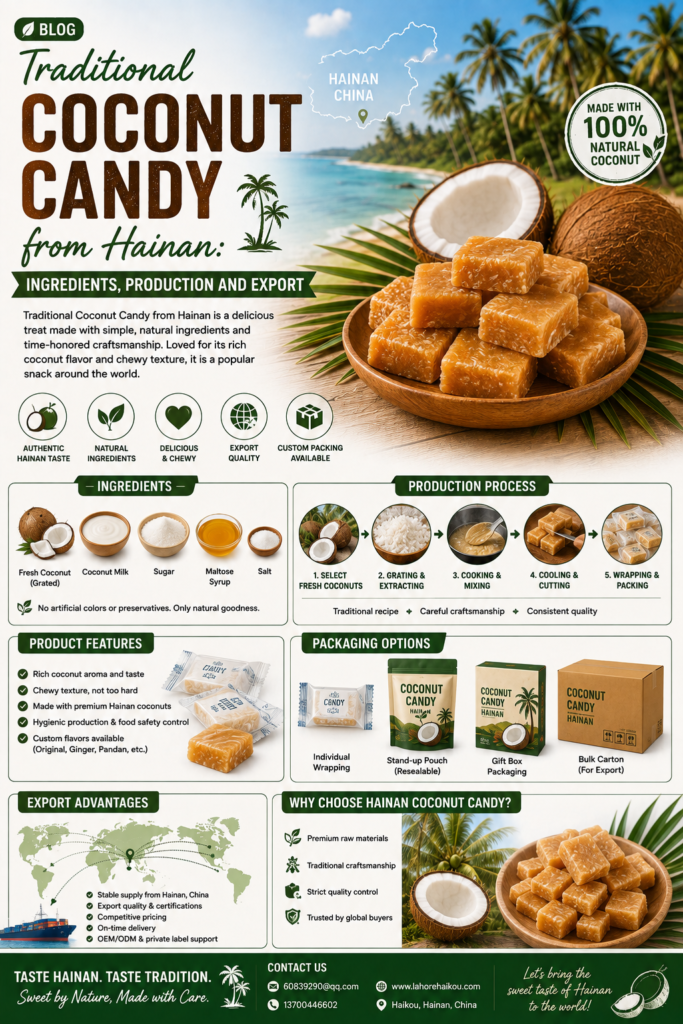
Coconut candy combines the natural flavor of coconut with sweet ingredients to create a snack that can be sold as a traditional product, souvenir, retail confectionery, or private-label food item.
For international buyers, understanding the ingredients, manufacturing process, packaging, quality requirements, minimum order quantities, and export procedures is important before placing a bulk order.
This guide explains what buyers should know when sourcing traditional coconut candy from Hainan, China.
What Is Traditional Coconut Candy?
Traditional coconut candy is a confectionery product made primarily with coconut and sweetening ingredients.
Depending on the manufacturer and recipe, coconut candy may have a:
- Soft texture
- Chewy texture
- Firm texture
- Caramelized texture
- Coconut-rich flavor
Different manufacturers may use different recipes and processing methods.
Some products may contain coconut milk or coconut cream, while others may use coconut flakes, desiccated coconut, coconut powder, or coconut extract.
For this reason, international buyers should always request the manufacturer’s exact ingredient list and product specification.
Why Is Coconut Candy Associated with Hainan?
Coconut trees are an important part of Hainan’s agricultural landscape and tourism culture.
Wenchang in particular has a strong connection with coconut cultivation, while coconut products are consumed and manufactured across Hainan.
Coconut-based snacks are attractive to tourists and consumers because they combine:
- Local ingredients
- Tropical flavor
- Traditional food culture
- Gift appeal
- Convenient packaging
This makes coconut candy potentially suitable for both domestic and international markets.
Traditional Coconut Candy Ingredients
The exact recipe varies between manufacturers.
Common ingredients may include:
Coconut
Coconut provides the main flavor and texture.
Depending on the recipe, manufacturers may use:
- Fresh coconut
- Coconut flakes
- Desiccated coconut
- Coconut milk
- Coconut cream
- Coconut powder
Sugar
Sugar provides sweetness and contributes to the texture of the candy.
Glucose Syrup or Other Sweeteners
Some confectionery manufacturers may use glucose syrup or other approved sweetening ingredients to achieve a particular texture.
Dairy Ingredients
Some recipes may contain milk powder, condensed milk, butter, or other dairy ingredients.
Other Ingredients
Depending on the product, manufacturers may use:
- Salt
- Flavoring
- Stabilizers
- Emulsifiers
- Other permitted food ingredients
International buyers should always obtain the final ingredient declaration before ordering.
Coconut Candy Production Process
The manufacturing process depends on the specific recipe.
A typical production process may involve several stages.
Step 1: Coconut Preparation
Coconut material is selected and prepared.
Fresh coconut may be:
- Opened
- Shelled
- Washed
- Grated
- Processed into coconut milk
Alternatively, manufacturers may use prepared coconut ingredients.
Step 2: Ingredient Preparation
The coconut ingredient is combined with the other ingredients according to the recipe.
The proportions can significantly affect:
- Sweetness
- Texture
- Flavor
- Moisture
- Shelf life
Step 3: Cooking
The mixture is heated under controlled conditions.
Cooking helps develop the desired:
- Texture
- Flavor
- Color
- Consistency
Temperature and cooking time depend on the formulation.
Step 4: Mixing
The ingredients are mixed until the desired consistency is achieved.
Commercial production may use industrial mixing equipment to maintain consistency between batches.
Step 5: Cooling
After cooking, the candy mixture is cooled under controlled conditions.
Cooling allows the product to develop its final texture.
Step 6: Cutting and Forming
The candy can then be:
- Cut into pieces
- Rolled
- Molded
- Individually shaped
The shape depends on the manufacturer’s product design.
Step 7: Individual Wrapping
Individual wrapping helps protect the candy from:
- Moisture
- Contamination
- Physical damage
It also improves convenience for retail customers.
Step 8: Final Packaging
The individually wrapped pieces may be packed into:
- Bags
- Boxes
- Plastic containers
- Gift boxes
- Retail cartons
Custom packaging can also be developed for private-label customers.
Different Types of Coconut Candy
International buyers may find several varieties.
Soft Coconut Candy
Soft coconut candy generally has a tender or chewy texture.
Chewy Coconut Candy
This style is designed to provide a more elastic or chewy eating experience.
Coconut Toffee
Coconut can be incorporated into a caramel or toffee-style confection.
Coconut Milk Candy
Some products use coconut milk as an important ingredient.
Coconut Flake Candy
Coconut flakes or shredded coconut may provide a more visible coconut texture.
Coconut Candy with Other Flavors
Manufacturers may develop combinations involving ingredients such as:
- Chocolate
- Sesame
- Peanut
- Mango
- Pineapple
- Coffee
Any added ingredients should be clearly specified for food-safety and labeling purposes.
What International Buyers Should Check
Before purchasing coconut candy, request a detailed product specification.
Important information can include:
- Product name
- Ingredients
- Net weight
- Individual piece weight
- Moisture content
- Nutritional information
- Shelf life
- Storage conditions
- Packaging
- Country of origin
- Manufacturer information
If you are importing the product for retail sale, make sure the documentation supports the labeling requirements of your destination country.
Food Safety and Quality Control
Food safety is one of the most important considerations when sourcing confectionery.
Ask suppliers about their food-safety management systems and relevant certifications.
Depending on the supplier and destination market, certifications may include:
- HACCP
- ISO 22000
- BRCGS
- FSSC 22000
- Halal
- Kosher
- Organic certification, where applicable
Not every certification is necessary for every market.
The buyer should determine which standards are required by the destination country and customers.
Allergens
Coconut candy may contain or be manufactured alongside common allergens.
Depending on the recipe and facility, potential allergens may include:
- Milk
- Peanuts
- Tree nuts
- Soy
- Sesame
- Other regulated allergens
Ask the manufacturer for an allergen statement.
This is particularly important when developing products for markets with strict food-labeling regulations.
Shelf Life
Shelf life is an important consideration when exporting coconut candy.
Ask the supplier:
- What is the shelf life?
- What is the recommended storage temperature?
- What humidity conditions are recommended?
- How should the product be transported?
- What is the minimum remaining shelf life at shipment?
Candy can be sensitive to heat and humidity, so appropriate packaging and transportation conditions are important.
Packaging Options
Coconut candy can be packaged in different formats depending on the target market.
Individual Wrapping
Suitable for:
- Retail
- Convenience stores
- Tourist shops
- Food-service applications
Retail Bags
Useful for supermarkets and general retail.
Gift Boxes
Attractive for:
- Tourist products
- Premium products
- Festivals
- Corporate gifts
Bulk Food-Service Packaging
Suitable for:
- Restaurants
- Hotels
- Distributors
- Repackaging companies
Private-Label Coconut Candy
International businesses may consider private-label coconut candy.
A manufacturer can potentially produce coconut candy under your own brand.
Private-label options may include:
- Custom recipe
- Custom flavor
- Custom shape
- Custom packaging
- Custom labels
- Different package sizes
- Retail gift boxes
Before beginning a private-label project, discuss:
- Minimum order quantity
- Packaging costs
- Product-development fees
- Artwork requirements
- Production time
- Food certifications
- Label requirements
Coconut Candy for Tourism and Gift Markets
Hainan is a major tourism destination, making coconut-based products potentially suitable for souvenir and gift markets.
A coconut candy product can be positioned as:
- A Hainan souvenir
- Tropical confectionery
- Chinese regional specialty
- Tourist gift
- Hotel gift
- Corporate gift
- Retail snack
Packaging can emphasize the product’s connection to Hainan while meeting the labeling requirements of the target market.
Wholesale Coconut Candy from Hainan
International wholesalers should determine their expected purchasing volume before contacting suppliers.
Typical questions include:
- What is the MOQ?
- What is the price per kilogram?
- What is the price per box?
- How many pieces are included?
- What packaging is available?
- What is the production capacity?
- What is the lead time?
A bulk order may receive a different price from a small trial order.
How to Compare Coconut Candy Suppliers
Don’t compare suppliers only by price.
Consider:
| Factor | What to Check |
|---|---|
| Ingredients | Coconut and other ingredients |
| Taste | Sample evaluation |
| Texture | Soft, chewy or firm |
| Quality | Consistency between batches |
| Shelf life | Remaining life at shipment |
| Packaging | Retail or bulk |
| MOQ | Minimum order |
| Certifications | Relevant food certifications |
| Production capacity | Ability to supply regularly |
| Private label | Customization options |
| Lead time | Production schedule |
| Documentation | Export and food documents |
| Price | Based on identical specifications |
A supplier offering a lower price may be using a different recipe, packaging format, or product specification.
Request Samples Before Ordering
Always request samples before placing a large order.
Evaluate:
- Coconut flavor
- Sweetness
- Texture
- Aroma
- Appearance
- Individual wrapping
- Packaging quality
- Product consistency
If you plan to sell the product under your own brand, test the product with your target customers before committing to a large production run.
How to Request a Coconut Candy Quotation
A detailed inquiry can help suppliers provide accurate quotations.
For example:
Product: Traditional Coconut Candy
Quantity: 5,000 kg
Packaging: Individual wrapping + retail box
Pieces per box: [Required quantity]
Target market: [Country]
Private Label: Yes/No
Required certifications: [List]
Shelf life: [Required period]
Delivery: FOB/CIF
Destination port: [Port]
Ask suppliers to provide:
- Price
- MOQ
- Product specification
- Ingredient list
- Sample
- Packaging details
- Shelf life
- Certifications
- Production lead time
- Export experience
- Shipping terms
Exporting Coconut Candy from Hainan
Coconut candy is a processed food product, so export requirements depend on both China-side procedures and the regulations of the destination country.
International buyers should consider:
- Food regulations
- Customs requirements
- Product classification
- Labeling
- Ingredients
- Nutrition information
- Allergen declarations
- Shelf life
- Packaging
- Export documentation
The requirements can vary significantly from one destination market to another.
Documents for International Buyers
Depending on the transaction and destination, documentation may include:
- Commercial invoice
- Packing list
- Sales contract
- Certificate of Origin
- Bill of lading
- Product specification
- Certificate of Analysis
- Food-safety documentation
- Ingredient declaration
- Relevant certification
Your customs broker or import specialist can confirm which documents are required for your country.
Shipping Coconut Candy Internationally
Coconut candy generally does not require refrigerated shipping if the specific product is shelf-stable and the manufacturer confirms suitable storage conditions.
However, buyers should consider:
- Temperature
- Humidity
- Packaging
- Container conditions
- Transit time
- Shelf life
- Seasonal weather
In hot climates, appropriate packaging can be particularly important to prevent melting, sticking, deformation, or other quality problems.
Questions to Ask a Hainan Coconut Candy Supplier
Before placing an order, ask:
- Are you the manufacturer?
- Where is your production facility?
- What type of coconut do you use?
- What is the complete ingredient list?
- Does the product contain dairy?
- Does it contain peanuts or other allergens?
- What is the shelf life?
- What are the storage conditions?
- What is the MOQ?
- Can you provide samples?
- What packaging options are available?
- Can you provide private-label packaging?
- What certifications do you have?
- Can you provide a Certificate of Analysis?
- What is your monthly production capacity?
- Do you export to international markets?
- What documents can you provide?
- What is the production lead time?
- What are your payment terms?
- What shipping terms can you offer?
Common Mistakes When Buying Coconut Candy
Choosing Only by Price
Different recipes and ingredient ratios can produce very different products.
Ordering Without Samples
Always evaluate the actual candy before placing a large order.
Ignoring Allergens
Check the ingredient and allergen declarations carefully.
Not Checking Shelf Life
International shipping can take time, so calculate the remaining shelf life when the product reaches your market.
Ignoring Packaging
Poor packaging can cause problems during long-distance transportation.
Not Checking Import Regulations
Confirm your country’s food-import and labeling requirements before ordering.
Paying Without Supplier Verification
Conduct appropriate supplier due diligence before making a substantial payment.
A Step-by-Step Coconut Candy Sourcing Process
Step 1 — Define Your Product
Choose:
- Candy type
- Ingredients
- Texture
- Flavor
- Packaging
- Quantity
Step 2 — Identify Suppliers
Research coconut candy manufacturers and suppliers in Hainan.
Step 3 — Request Samples
Test the product before negotiating a large order.
Step 4 — Compare Suppliers
Compare specifications, quality, certifications, MOQ, price, and production capacity.
Step 5 — Verify the Supplier
Check company information, factory capability, certifications, and export experience.
Step 6 — Confirm Packaging
Make sure the packaging is appropriate for your target market and shipping conditions.
Step 7 — Check Import Requirements
Confirm destination-country food, labeling, and customs requirements.
Step 8 — Finalize the Order
Agree on:
- Product
- Quantity
- Packaging
- Price
- Payment
- Lead time
- Incoterms
Step 9 — Quality Control
Consider an appropriate inspection before shipment.
Step 10 — Arrange Shipping
Coordinate export documentation, freight, customs, and destination delivery.
Why Work with a Local Sourcing Partner?
International buyers who do not speak Chinese or are unfamiliar with the Hainan supplier market may benefit from local sourcing assistance.
A sourcing partner can potentially help with:
- Finding suppliers
- Chinese-language communication
- Supplier negotiations
- Sample collection
- Product specifications
- Factory communication
- Quality inspection
- Packaging coordination
- Shipping
- Export documentation
For first-time buyers, local support can make the sourcing process easier to manage.
Final Thoughts
Traditional coconut candy from Hainan combines a familiar tropical ingredient with the region’s food culture and tourism appeal.
For international buyers, the product can potentially be developed for:
- Supermarkets
- Convenience stores
- Tourist shops
- Hotels
- Gift stores
- Online stores
- Food distributors
- Private-label brands
Successful sourcing requires careful attention to ingredients, taste, texture, food safety, allergens, shelf life, packaging, MOQ, certifications, supplier capability, and export requirements.
Before placing a bulk order, request samples, verify the supplier, review the product specification, confirm the packaging, and check your destination country’s food-import regulations.
With the right supplier and product positioning, Hainan coconut candy can be an interesting addition to an international snack or specialty-food portfolio.
START YOUR CHINA SOURCING JOURNEY TODAY
📱 13700446602
📍 Haikou, Hainan, China
Looking for Coconut Products from Hainan?
We can help international buyers explore sourcing opportunities for:
- Traditional Coconut Candy
- Coconut Milk
- Coconut Cream
- Coconut Oil
- Coconut Water
- Desiccated Coconut
- Coconut Powder
- Coconut Shell Charcoal
- Coconut Shell Powder
- Coir Fiber
- Coco Peat
- Other Coconut Products
Send us your product requirements, quantity, packaging specifications, target market, and destination to discuss your sourcing needs.
Source from Hainan. Connect with Chinese suppliers. Build your international business.