Hainan is one of China’s important coconut-producing regions, making it an interesting sourcing destination for international buyers looking for coconut-based ingredients. Wenchang, in particular, is well known for its coconut industry and can be a useful location for buyers searching for coconut flour and other coconut products.
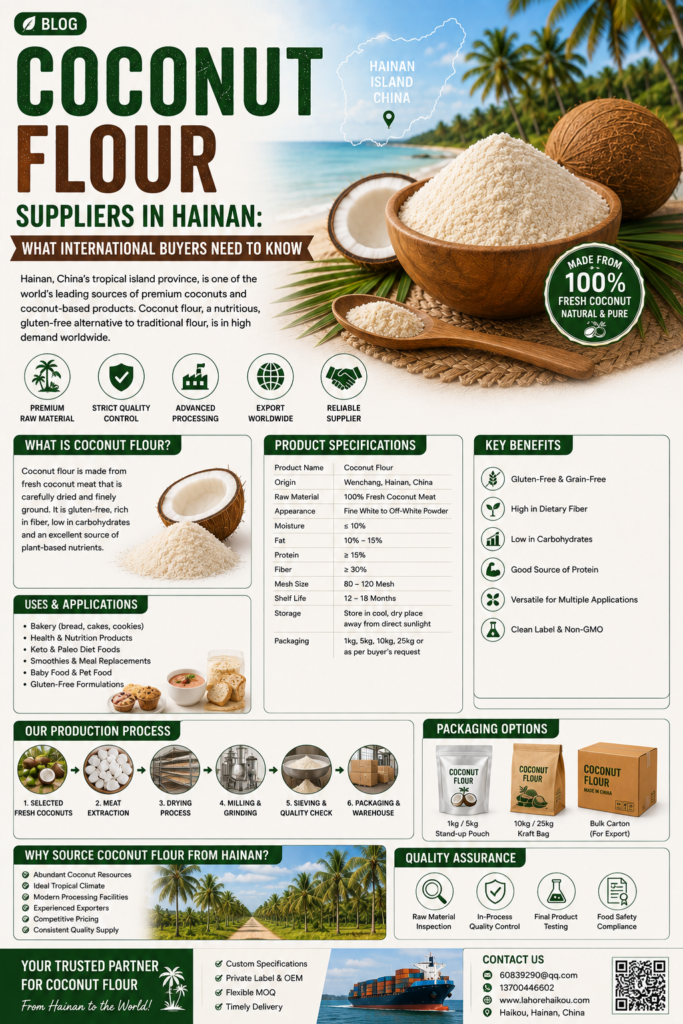
For wholesalers, food manufacturers, bakeries, distributors, health-food companies, and private-label brands, sourcing coconut flour in bulk requires more than simply finding the lowest price. Buyers should understand the product specification, processing method, nutritional composition, food-safety requirements, packaging, MOQ, certifications, and export capabilities of the supplier.
This guide explains what international buyers should know when looking for coconut flour suppliers in Hainan, China.
WHAT IS COCONUT FLOUR?
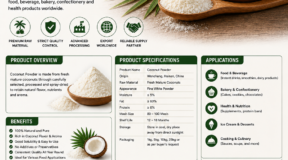
Coconut flour is a finely ground coconut-based ingredient generally produced by drying and milling coconut material. Depending on the production process, it may be made from coconut meat or coconut material remaining after coconut oil or coconut milk extraction.
Coconut flour is commonly:
- Fine in texture
- Naturally coconut-flavored
- Light cream to light brown in color
- Rich in dietary fiber
- Suitable for different food applications
The exact nutritional composition depends on how the coconut is processed.
Coconut flour may be full-fat, partially defatted, or highly defatted. Therefore, international buyers should clearly specify the type of coconut flour they require before requesting a quotation.
WHY CONSIDER HAINAN FOR COCONUT FLOUR?
Hainan has a strong connection with coconut cultivation and coconut processing, with Wenchang being particularly associated with the coconut industry.
The wider Hainan coconut industry produces a variety of coconut-based products, including:
- Coconut flour
- Coconut powder
- Coconut milk powder
- Coconut milk
- Coconut cream
- Coconut oil
- Coconut water
- Desiccated coconut
- Coconut candy
- Coconut shell charcoal
- Coconut shell powder
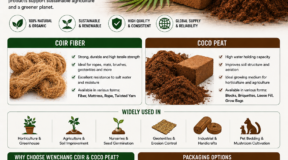
- Coir fiber
- Coco peat
For international buyers, this makes Hainan an interesting region to investigate when sourcing coconut ingredients from China.
However, buyers should verify each supplier individually. A company involved in coconut processing may specialize in coconut milk, coconut oil, or other products rather than coconut flour.
HOW IS COCONUT FLOUR PRODUCED?
The production process depends on the manufacturer’s product specification.
A typical coconut flour production process may include the following steps.
- Coconut Selection
Mature coconuts are selected as raw material.
The quality of the coconut can influence the final product’s:
- Flavor
- Aroma
- Color
- Nutritional composition
- Coconut Meat Preparation
The coconuts are opened and the coconut meat is separated from the shell.
The coconut material is cleaned and prepared for further processing.
- Oil or Milk Extraction
For some defatted coconut flour products, part of the coconut oil is removed during processing.
The remaining coconut material can then be used as the raw material for flour production.
- Drying
The coconut material is dried to reduce moisture.
Moisture control is important for product stability and storage.
- Milling
The dried coconut material is finely ground into coconut flour.
- Sieving
The powder can be sieved to achieve the required particle size.
- Quality Testing
The finished product may be tested for:
- Moisture
- Fat
- Protein
- Fiber
- Ash
- Microbiological quality
- Foreign matter
- Particle size
- Packaging
The finished coconut flour is packed in food-grade bags or customized retail packaging.
FULL-FAT VS. DEFATTED COCONUT FLOUR
One of the most important questions for a buyer is whether the coconut flour is full-fat or defatted.
FULL-FAT COCONUT FLOUR
Full-fat coconut flour retains more of the natural coconut oil.
Potential characteristics include:
- Strong coconut flavor
- Richer mouthfeel
- Higher fat content
However, the higher residual oil content may affect shelf stability and oxidation.
DEFATTED COCONUT FLOUR
Defatted coconut flour contains less residual coconut oil because more of the fat has been removed during processing.
It can be suitable for:
- Gluten-free baking
- Health-food products
- High-fiber foods
- Baking mixes
- Nutrition products
The exact fat content varies between suppliers, so buyers should specify their required percentage.
KEY SPECIFICATIONS INTERNATIONAL BUYERS SHOULD CHECK
Before requesting a quotation, define your technical requirements.
Important specifications may include:
- Product type
- Coconut source
- Fat percentage
- Moisture
- Protein
- Dietary fiber
- Ash
- Particle size
- Bulk density
- Color
- Aroma
- Taste
- Microbiological limits
- Shelf life
- Storage conditions
- Packaging
There is no single specification that applies to every coconut flour product.
Therefore, buyers should establish their own product specification according to their intended application and destination market.
MOISTURE CONTENT
Moisture is an important quality parameter for coconut flour.
High moisture can contribute to:
- Clumping
- Reduced shelf stability
- Microbial problems
- Changes in texture
- Storage difficulties
When buying in bulk, ask the supplier for the maximum moisture level and the testing method used.
Make sure the moisture requirement is included in the agreed product specification.
DIETARY FIBER
Coconut flour is popular in many food applications because of its relatively high dietary-fiber content.
The actual fiber content depends on the production method and degree of processing.
If dietary fiber is important to your product, request a laboratory analysis or Certificate of Analysis rather than relying only on a general product description.
PROTEIN CONTENT
Protein content can vary between coconut flour products.
The production process, coconut variety, and degree of defatting can influence the nutritional profile.
If you are manufacturing nutritional or health-food products, specify the minimum protein level you require.
PARTICLE SIZE
Particle size can affect the performance of coconut flour in food production.
Depending on the application, buyers may require:
- Fine powder
- Medium powder
- Specific mesh size
- Specific micron range
Fine coconut flour may be suitable for:
- Cakes
- Cookies
- Baking mixes
- Pancakes
- Nutrition products
Always request the supplier’s particle-size specification and test the sample in your own production process.
COCONUT FLOUR FOR GLUTEN-FREE PRODUCTS
Coconut flour is naturally made from coconut rather than wheat, making it attractive for gluten-free food formulations.
However, naturally gluten-free does not automatically mean certified gluten-free.
If you plan to make a gluten-free claim, ask the supplier about:
- Gluten testing
- Testing methods
- Cross-contact controls
- Gluten-free certification
The requirements can vary depending on the destination country.
APPLICATIONS OF COCONUT FLOUR
Coconut flour can be used in many food industries.
BAKERY PRODUCTS
Potential applications include:
- Bread
- Cakes
- Cookies
- Biscuits
- Muffins
- Brownies
- Pancakes
- Baking mixes
HEALTH FOODS
Coconut flour can be used in:
- High-fiber foods
- Nutrition bars
- Health-food mixes
- Functional food products
GLUTEN-FREE FOODS
Coconut flour can be incorporated into many gluten-free formulations.
SNACK PRODUCTS
Manufacturers may use coconut flour in:
- Energy bars
- Baked snacks
- Nutrition snacks
- Snack mixes
BEVERAGE AND SMOOTHIE PRODUCTS
Fine coconut flour may be used in selected nutritional formulations.
However, coconut flour has strong water-absorption characteristics, so food manufacturers should test the ingredient carefully when developing recipes.
WHAT SHOULD YOU ASK A HAINAN COCONUT FLOUR SUPPLIER?
Before placing an order, ask the supplier:
- Are you the manufacturer or trading company?
- Is the product manufactured in Hainan?
- Where is your factory located?
- What type of coconut flour do you manufacture?
- Is it full-fat or defatted?
- What is the fat percentage?
- What is the moisture level?
- What is the protein content?
- What is the dietary-fiber content?
- What is the particle size?
- Are any additives used?
- Is the product gluten-free?
- Is the product suitable for vegan applications?
- Can you provide a complete ingredient declaration?
- Can you provide a Certificate of Analysis?
- What microbiological tests are performed?
- What certifications do you have?
- What is the shelf life?
- What are the storage conditions?
- What is the MOQ?
- Can you provide samples?
- What packaging options are available?
- What is your monthly production capacity?
- Do you have international export experience?
- What export documents can you provide?
REQUEST A CERTIFICATE OF ANALYSIS
A Certificate of Analysis, commonly called a COA, is an important document for wholesale buyers.
Depending on the product, the COA may include:
- Moisture
- Fat
- Protein
- Fiber
- Ash
- Microbiological results
- Particle size
- Other technical parameters
For large or long-term orders, buyers may also consider independent laboratory testing.
The product specification agreed with the supplier should match the quality requirements of the finished product.
FOOD-SAFETY CERTIFICATIONS
Depending on your target market, you may require suppliers with certifications such as:
- HACCP
- ISO 22000
- FSSC 22000
- BRCGS
- Halal
- Kosher
- Organic certification
Not every certification is required for every product or country.
Ask suppliers for copies of their current certificates and check:
- Certificate number
- Certification body
- Expiry date
- Factory address
- Product scope
ORGANIC COCONUT FLOUR
If you plan to sell organic coconut flour, clearly communicate your certification requirements to the supplier.
Potential requirements may include:
- Organic certification
- Traceability
- Certified raw materials
- Approved processing
- Organic transaction documentation
Do not assume that terms such as “natural” or “chemical-free” are equivalent to organic certification.
PACKAGING FOR BULK COCONUT FLOUR
International suppliers may offer several packaging options.
Common formats include:
- 10 kg bags
- 20 kg bags
- 25 kg bags
- Food-grade PP bags
- Kraft bags with inner liners
- Laminated moisture-resistant bags
- Customized retail packaging
For international shipping, packaging should protect the powder against:
- Moisture
- Contamination
- Physical damage
- Odor absorption
Ask suppliers about their standard export packaging and container-loading arrangements.
PRIVATE-LABEL COCONUT FLOUR
International food brands may also consider private-label coconut flour.
Depending on the supplier, customization may include:
- Custom packaging
- Custom labels
- Different package sizes
- Retail-ready products
- Customized specifications
Before starting a private-label project, confirm:
- MOQ
- Packaging costs
- Artwork requirements
- Product specification
- Production lead time
- Certification requirements
- Label requirements
- Sample approval process
MINIMUM ORDER QUANTITY
The minimum order quantity varies from supplier to supplier.
MOQ may depend on:
- Product type
- Packaging
- Private label
- Custom formulation
- Production schedule
- Order quantity
A standard bulk product may have a lower MOQ than a customized private-label product.
If you are testing the market, ask whether the supplier can provide a trial quantity before committing to a large order.
HOW TO COMPARE COCONUT FLOUR SUPPLIERS IN HAINAN
Do not choose a supplier based only on the lowest price.
Compare suppliers using a structured evaluation.
Supplier evaluation factors should include:
- Manufacturer or trading company
- Factory location
- Product type
- Full-fat or defatted
- Moisture
- Fat
- Protein
- Fiber
- Particle size
- Ingredients
- COA
- Certifications
- MOQ
- Packaging
- Shelf life
- Production capacity
- Export experience
- Lead time
- Price
Always compare suppliers using identical product specifications.
A supplier offering a lower price may be offering a different grade or specification.
HOW TO REQUEST A COCONUT FLOUR QUOTATION
A professional RFQ should provide enough information for the supplier to calculate an accurate price.
Example:
Product: Coconut Flour
Origin: Hainan, China
Type: Defatted Coconut Flour
Fat: Maximum [X]%
Moisture: Maximum [X]%
Fiber: Minimum [X]%
Particle Size: [X mesh / micron]
Quantity: [X metric tons]
Packaging: 25 kg food-grade bags
Certifications: [Required certifications]
Private Label: Yes / No
Target Market: [Country]
Destination Port: [Port]
Trade Term: FOB / CIF
Ask the supplier to provide:
- Price per kg
- MOQ
- Product specification
- Ingredient declaration
- COA
- Certifications
- Sample availability
- Packaging details
- Shelf life
- Storage requirements
- Production capacity
- Production lead time
- Export documentation
- Payment terms
SHIPPING COCONUT FLOUR FROM HAINAN
For international buyers, the product price is only one part of the total purchasing cost.
The total landed cost may include:
Product + Packaging + Inland Transportation + Export Charges + Freight + Insurance + Import Duties + Customs + Local Delivery
When requesting a quotation, clarify whether the price is based on:
- EXW
- FOB
- CIF
- CFR
- DAP
- DDP
Make sure you understand which costs are included and which party is responsible for transportation, insurance, customs, and delivery.
EXPORT DOCUMENTATION
Depending on the destination country and transaction, export documentation may include:
- Commercial invoice
- Packing list
- Sales contract
- Certificate of Origin
- Bill of lading
- Product specification
- Certificate of Analysis
- Food-safety documentation
- Organic documentation, where applicable
- Other regulatory documents
Import requirements differ from country to country.
Before ordering, confirm the requirements with your customs broker, importer, or relevant food regulatory authority.
QUALITY INSPECTION BEFORE SHIPMENT
For a first order or large purchase, consider conducting a pre-shipment inspection.
An inspection can check:
- Product quantity
- Packaging
- Labeling
- Batch numbers
- Manufacturing dates
- Product appearance
- Bag condition
- Documentation
For critical specifications, independent laboratory testing can provide additional assurance.
COMMON MISTAKES INTERNATIONAL BUYERS MAKE
- Buying Based Only on Price
Always compare identical technical specifications.
- Not Defining Fat Content
Full-fat and defatted coconut flour have different characteristics.
- Not Checking Ingredients
Confirm whether the product is pure coconut flour or contains additional ingredients.
- Ordering Without a Sample
Always test the product before placing a large order.
- Assuming Gluten-Free Certification
Naturally gluten-free does not automatically mean certified gluten-free.
- Ignoring Moisture
Moisture can affect storage and product stability.
- Not Checking Particle Size
Particle size can influence baking and formulation performance.
- Ignoring Export Experience
A supplier that sells domestically may not have experience with international documentation and logistics.
- Not Verifying Certifications
Request copies of certificates and verify their validity.
- Paying Before Supplier Verification
Conduct reasonable supplier due diligence before making a substantial payment.
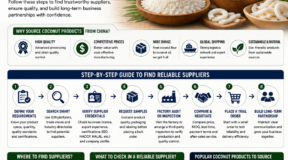
STEP-BY-STEP GUIDE TO BUYING COCONUT FLOUR FROM HAINAN
STEP 1 — DEFINE YOUR REQUIREMENTS
Determine:
- Product type
- Fat level
- Moisture
- Fiber
- Protein
- Particle size
- Packaging
- Quantity
STEP 2 — FIND POTENTIAL SUPPLIERS
Research coconut flour manufacturers and processors in Wenchang and other areas of Hainan.
STEP 3 — REQUEST PRODUCT SPECIFICATIONS
Ask for the complete technical specification and ingredient declaration.
STEP 4 — REQUEST SAMPLES
Test the product in your intended application.
STEP 5 — COMPARE SUPPLIERS
Evaluate:
- Quality
- Specifications
- Certifications
- MOQ
- Price
- Production capacity
- Lead time
- Export experience
STEP 6 — VERIFY THE SUPPLIER
Confirm company information, factory capability, certifications, and export history.
STEP 7 — NEGOTIATE THE ORDER
Confirm:
- Product
- Quantity
- Price
- Packaging
- Payment terms
- Incoterms
- Delivery schedule
STEP 8 — CONDUCT QUALITY CONTROL
Use inspection or laboratory testing when appropriate.
STEP 9 — ARRANGE SHIPPING
Coordinate freight, customs, export documentation, and destination delivery.
STEP 10 — INSPECT THE SHIPMENT
Check the received product against the approved product specification.
WHY WORK WITH A CHINA SOURCING PARTNER?
For international buyers unfamiliar with Chinese suppliers, sourcing directly can sometimes be challenging.
A local sourcing partner can potentially assist with:
- Supplier identification
- Chinese-language communication
- Factory communication
- Supplier verification
- Price negotiation
- Sample collection
- Product inspection
- Packaging
- Logistics
- Export coordination
This can be especially useful when you are sourcing several coconut products from Hainan at the same time.
FINAL THOUGHTS
Coconut flour suppliers in Hainan can be worth exploring for international food manufacturers, wholesalers, distributors, bakeries, health-food companies, and private-label brands.
Wenchang’s connection with coconut cultivation and processing makes it a logical location to investigate, but buyers should always verify the capabilities of each individual supplier.
Before placing a wholesale order, clearly define your:
- Product type
- Fat level
- Moisture
- Fiber
- Protein
- Particle size
- Ingredients
- Microbiological requirements
- Certifications
- Packaging
- Shelf life
- MOQ
- Delivery terms
Most importantly, request samples and batch-specific documentation before committing to a large purchase.
A careful sourcing process can help international buyers find a coconut flour product that matches their manufacturing requirements while reducing the risks associated with international food-ingredient purchasing.
START YOUR CHINA SOURCING JOURNEY TODAY
Email: 60839290@qq.com
Phone / WhatsApp: 13700446602
Website: www.lahorehaikou.com
Location: Haikou, Hainan, China
LOOKING FOR COCONUT PRODUCTS FROM HAINAN?
We can help international buyers explore sourcing opportunities for:
- Coconut Flour
- Coconut Powder
- Coconut Milk Powder
- Coconut Cream Powder
- Coconut Milk
- Coconut Oil
- Coconut Water
- Traditional Coconut Candy
- Desiccated Coconut
- Coconut Shell Charcoal
- Coconut Shell Powder
- Coir Fiber
- Coco Peat
Send us your product specification, required quantity, packaging requirements, target market, and destination to discuss your sourcing requirements.
SOURCE FROM HAINAN. CONNECT WITH CHINESE SUPPLIERS. BUILD YOUR INTERNATIONAL BUSINESS.